Showing posts with label Exploration. Show all posts

Tuesday, March 7, 2017

Central Asia: An Emerging Player in the Global Oil & Gas Energy Sector

Central Asia, with the rapid development of its oil & gas sectors, is coming to the fore of the global energy landscape. 

In the past several years, Central Asia has been gaining prominence in the global energy sector. While the Middle East remains to be the vital energy exporter to key markets across the world, the recent development of Central Asia’s energy and oil & gas facilities has allowed it to increasingly perform a significant part in delivering the energy needs of crucial markets.

Courtesy www.GineersNow.com
Central Asia, comprising the former Soviet republics of Kazakhstan, Tajikistan, Turkmenistan, Kyrgyzstan, Azerbaijan, and Uzbekistan, has, in fact, long possessed immense volumes of oil and natural gas. It has estimated reserves of between 110 billion and 240 billion barrels of crude oil, valued at around USD 4 trillion. Unfortunately, they had largely remained underdeveloped due to lack of infrastructure. Owing to this, it was tremendously difficult for regional energy producers to transform the region’s raw natural resources to profitable output and to find suitable methods of delivery to target markets around the world.

With the presence of Soviet influence over the Central Asia’s energy sector, the region’s oil and gas resources were predominantly delivered to Russia, and from there channeled to other markets of Western Europe. But after the collapse of the Soviet Union in 1991, the Central Asian states sought to open their energy resources to new markets and started to take progressive initiatives to diversify their export destinations.

The instrumental partnerships: China

Central Asia’s quest to develop its energy sector on the heels of the fall of the Soviet Union was largely met with various challenges. The region’s perceived geopolitical risks, lack of industrial and civil infrastructure, and demographic difficulties had all reined in the development of its oil and gas industry.

In recent years, however, the tide has dramatically turned for Central Asia, as it found important energy partners in its neighbors, most notably in China. Aside from being a viable final point of trade, China’s investment towards Central Asia largely contributed to the rapid development of the region’s oil & gas resources, and in the stark regeneration and expansion of its energy market.

Courtesy www.GineersNow.com
China has been actively involved in various oil & gas projects in Central Asia, particularly in Kazakhstan, funding construction works and supplying technology and equipment, mostly to the upstream sector. Investing in Central Asia’s energy industry is a key component of China’s strategy to strengthen its oil & gas sector to, first, meet domestic energy demand and, then, export high-value energy products to key markets of the world.

China controls an estimated 20% of Kazakhstan’s oil production, and has participated in the construction of one of the world’s most extensive oil pipelines, stretching 2,300 km from the Caspian Sea to Xinjiang province. The China National Petroleum Corporation maintains a significant stake in the Kashagan oil field in the Caspian Sea, while other Chinese companies control several strategic oil fields around Aktobe, a city in the west of Kazakhstan.

China also has a significant participation in Kazakhstan’s most successful oil & gas companies. Some of the regional energy companies with Chinese holdings include MangystauMunaiGaz, CNPC-AktobeMunaiGas, KazGerMunay, KarazhanbasMunay, PetroKazakhstan, Buzachi Operating, Turgay Petroleum, Caspian Petroleum Company, Kazakhoil Aktobe, and KarakudukMunai.

Courtesy www.GineersNow.com
Aside from Kazakhstan, China has also become a significant customer and partner for Turkmenistan, Uzbekistan, Tajikistan and Kyrgyzstan. Regional energy companies, such as Tajiktransgaz and Uzbekneftergaz have signed agreements with China National Petroleum Corporation to cooperate in the construction of the Central Asia-China Gas Pipeline that facilitates the delivery of Central Asia’s gas resources to China.

Aside from Chinese oil & gas firms, Central Asia has also attracted international oil & gas majors to participate in geological surveys, exploratory activities and other energy-related processes. These include ExxonMobil, Shell, Chevron, Conoco, and Eni.

The power to go further

The partnership with international oil & gas firms, particularly with those from China, has clearly accelerated Central Asia’s emergence as a significant player in the world energy market. The development of new energy infrastructure, exploration facilities, refineries and large-scale pipeline projects are expected to continue in the coming years, with more deals being signed among the Central Asian countries and prospective international investors.

Now, more than ever, a reliable source of electrical energy will be necessary to provide power to the existing energy facilities and to the future infrastructure construction projects in Central Asia. With market opportunities abound, Central Asia cannot afford to slow down at the risk of losing its momentum. This is the time when Central Asia needs a reliable power partner that can provide suitable power generation technologies to its energy and oil & gas market.


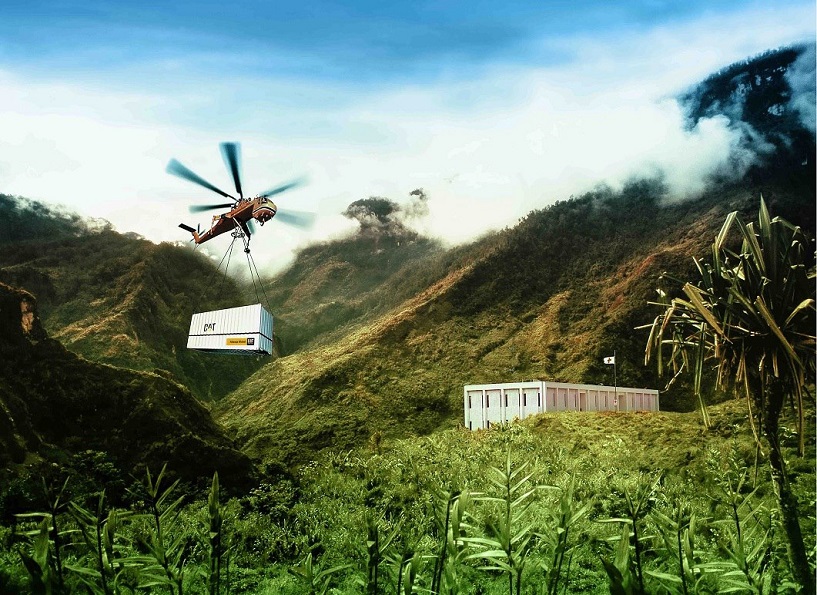
Temporary power plants represent a power generation technology highly suitable to Central Asia’s oil and gas market. They can be delivered and installed anywhere in the world, even in remote areas where oil & gas facilities are usually located or constructed. They can be configured in various ways so that they fit even in the limited spaces that are usually left available in oil & gas facilities.

They are highly scalable so that they can provide the precise amount of power needed in the different processes of an oil & gas operation. For example, an oil & gas operator can opt to start with a small power plant during the less energy-intensive stages, and then ramp up its capacity as operations expand and as processes require more power. This is particularly important for oil & gas investors because this eliminates the need to invest in permanent power plants at the early stages, which can be left inefficiently running at part-load most of the time.

Modern rental power plants are equipped with cutting-edge protection systems that ensure a safe operation within oil & gas facilities. Additionally, they will be expertly installed, operated and maintained by certified electrical engineers from the service provider so oil & gas operators can rest assured that the power plants will remain efficient and reliable throughout the service.

For more information on the benefits of temporary power for oil & gas operations, please visit: http://www.altaaqaglobal.com/industries/oil-gas

 The remarkable potential

Industry insiders say that Central Asia is set to become a dominant player in the global energy market. Central Asia possesses some of the world’s largest oil & gas fields, and though several of which are already being developed, there still remain many areas in the region where a substantial potential exists. As the region’s oil & gas sector is further developed by future regional and international investments, Central Asia will progressively gain prominence as a major producer of energy and fuels, and as a vital energy transportation link between various regions of Eurasia.


-Ends-


*This article has been previsouly published at www.gineersnow.com, https://www.gineersnow.com/industries/oil-gas/central-asia-emerging-player-global-oil-gas-energy-sector


Sources consulted:

http://thediplomat.com/2016/08/central-asias-oil-and-gas-now-flows-to-the-east/
http://www.worldfinance.com/markets/central-asia-a-major-player-in-the-oil-and-gas-energy-industry
http://www.arabianoilandgas.com/article-16239-central-asias-new-pivotal-role/1/print/


PRESS INQUIRIES
Altaaqa Global
Tel: +971 56 1749505
rbagatsing@altaaqaglobal.com

Monday, February 27, 2017

Current Trends in the Oil & Gas Industry of the Asia-Pacific

The Asia-Pacific is keen on boosting the productivity of new and established oil and gas reserves within its territories. 

The Asia-Pacific’s demand for oil and gas continues to rise as it witnesses rapid urbanization and industrialization. At the moment, the Asia-Pacific is said to be consuming approximately 25% of the world’s oil supply, 45% of coal and 10% of natural gas. While it has traditionally supported its demand with exports from other regions, at present countries in the Asia-Pacific are taking significant steps towards decreasing import dependency and boosting regional energy security and autonomy.

Courtesy www.gineersnow.com
In order to satisfy the increasing demand for energy, oil & gas and petrochemicals, and thus encourage further regional economic growth, the Asia-Pacific is keen on boosting the productivity of new and established oil and gas reserves within its territories.

Renewed Energy

Some of the more mature oil and gas reserves in the region are found in China and India, and in certain parts of Thailand, Malaysia, and Indonesia. Currently, new oil frontiers are being developed in other countries, like the Philippines and Myanmar. Exploration of unconventional oil and gas reserves in deeper and more remote waters is notably gaining traction.

National oil companies within the region, such as the China National Offshore Oil Corporation (CNOOC), India’s Oil and Natural Gas Corporation (ONGC), Malaysia’s Petronas, Thailand’s PTT and Vietnam’s PetroVietnam have taken the lead in investing in and developing the region’s oil & gas industry. Additionally, independent oil & gas companies and international oil companies are seeing increasing regional participation.

Courtesy www.gineersnow.com
American and European oil & gas titans have started ramping up their activities within the Asia-Pacific, with the keen interest of capitalizing on the region’s rapidly expanding market. Some of the more notable regional activities of international oil companies include Exxon Mobil’s agreed acquisition of Papua New Guinea’s InterOil, British Petroleum’s (BP) plans of expanding its Tangguh LNG project in Indonesia, and Chevron and Exxon Mobil’s bid to invest in an oil project in Kazakhstan, which is geared towards transporting crude to China. Other international players actively participating in the regional oil & gas activities include Reliance, Shell and Murphy.

Spotlight: In-field Power Generation Technologies

But while the Asia-Pacific oil & gas sector is gradually picking up the pace, the industry players remain cautious about the volatile prices, the challenges of exploration and production in harsh remote areas and other environmental and technological concerns. With this in mind, oil & gas operators are constantly in search of ways to enhance long-term production, control operational expenditure and minimize the environmental impact of their operations.

One aspect that industry players aim to optimize is in-field power generation, considered the life-blood of oil & gas operation.

Temporary power plants can prove to be a viable power generation option for oil & gas operations. Turning to rental power solutions can spare new and mature oil & gas companies alike from making a huge investment in permanent power facilities amidst this uncertain economic climate. Opting to rent power plants will not require a substantial capital investment, and the power produced can be easily paid from operational revenues. Because rental power plants are completely scalable, they can support the energy requirements of various processes of oil & gas operations of any size.


Temporary power plants can be transported from and to virtually anywhere in the world, even in extremely remote areas where new oil & gas facilities are being established. Equipment comprising rental power stations are enclosed in industry-grade containers so they are suitable for safe and reliable operation even in the harshest environments. They are modular so they can be laid out and installed in various configurations even in the limited spaces available in oil & gas facilities.

At present, many oil & gas facilities are realizing the economic and environmental advantages of using natural gas to provide power for its operations. While oilfield equipment is traditionally powered by diesel generators, natural gas generators are progressively gaining utilization in oil & gas operations. Its growth within the industry is largely spurred by the development of modern power generation solutions capable of running on-site natural gas, the increase in unconventional gas resources and the strict implementation of emission regulations in many countries around the world.

For more information on how rental power plants can be beneficial to oil & gas operations, visit: http://www.altaaqaglobal.com/industries/oil-gas


What Lies Ahead

The Asia-Pacific is expecting continued economic growth of 7.3% in the coming years. What this means is that the region’s energy demand will proportionally increase. This, in addition to the modest recovery in crude prices, drives the expansion of the oil and gas market in the Asia-Pacific. But while national and international oil & gas players are excitedly looking to ride this new growth wave, they remain optimistically cautious of the industry’s prospects. Having said this, they remain on the look-out for innovations and technologies that can enhance their productivity and mitigate any associated risks.


-Ends-


PRESS INQUIRIES
Altaaqa Global
Tel: +971 56 1749505
rbagatsing@altaaqaglobal.com


Sources consulted: 

http://www.marketwatch.com/story/asia-pacific-upstream-oil-gas-services-market-to-grow-at-4-cagr-through-2021-2016-11-08-22034846

http://erm-academy.org/publication/risk-management-article/changes-asia-pacific-oil-and-gas-segment

http://asia.nikkei.com/Business/Trends/Energy-majors-look-to-Asia-Pacific-for-growth

http://altaaqaglobal.blogspot.ae/2016/04/utilizing-stranded-gas-to-boost-long.html

Monday, January 18, 2016

Rental Power Plants: Providing Reliable Electricity to the Mining Industry

A persistent shortage and instability in the supply of power around the world, in some instances for reasons beyond any party’s control, has pushed many countries and mining operators to agree to reduce power supply to mining sites. The electricity supply insufficiency and the consequent load shedding, on top of increasing overhead costs and continuously weakening commodity prices, have driven mining companies in different regions to scale down or suspend operations altogether.


“Some parts of mining operations will be halted or scaled back to cope with the regular power cuts,” say an industry player. “Electricity,” he adds, “is not only utilized in the actual mining and processing, but also in maintenance. So, we are particularly preoccupied about our old underground mines, because there power is an exceedingly high overhead cost.” He believes that with the way things are going at the present, the immediate solution to save the business is to lay off workers, by the thousands.

Some entities have tried surmounting the challenge by importing power from their neighboring countries. But while it is not a guarantee of a continuous power supply, introducing power from other countries have led to an increased cost of running mining operations, owing to higher electricity prices.

Some operators have installed local power generation systems to support the supply of electricity to the mining sites, but their power production is not always enough to run the energy-intensive processes of a large-scale mining operations, including exploration, production, and climate control.

In times of persistent power shortage, mining companies will find hiring the services of temporary power providers beneficial to their operations. It is undeniable that electricity plays an essential role in mining operations, and renting large-scale power plants can guarantee a constant supply of reliable power to mining sites, without the need to spend scarce CAPEX in building permanent power facilities. In these difficult times for the industry, mining companies will appreciate the fact that they can pay for the electricity produced by hired power plants from their operating revenues. Mining companies can also choose to add power modules to the rental power plants as their operations expand and their requirement for electricity increase.

Rental power plants are not only reliable, they are fuel efficient and have less impact on the environment. Modern rental generators boast of cleaner operations, being able to run on a variety of fuels, including natural gas or a combination of gas and diesel. Studies conducted in different rental power plants sites around the world show that temporary power stations, like those running on natural gas, can surpass the worldwide NOx emission requirements, emitting only 250 mg/Nm3 even without after treatment.

The present times have not been favorable to the mining industry. Mining companies, established and start-ups alike, are struggling to maintain a profitable production, and this has resulted in job loss and limited expenditure. A reliable and consistent supply of electricity is one key solution to the survival and development of mining operations against the backdrop of these trying times, and rental power plants represent a technology that can guarantee just that.

End

PRESS INQUIRIES
Altaaqa Global
Tel: +971 56 1749505
rbagatsing@altaaqaglobal.com