Showing posts with label Altaaqa Global. Show all posts

Saturday, April 8, 2017

Tips to remain confident at work without appearing arrogant

To be a full-fledged engineer is a feat achieved only by a select few. Being a certified engineer entails continuous dedication, persistence and tenacity, on top of limitless creativity, imagination and ambition. As such, engineers take much pride in their profession.


Many engineers exude a “can-do” attitude, swag if you may, which they bring with them everywhere they go – including their place of work. Years of intensive education and myriad surmounted adversities have armed engineers with the confidence that they hold the solution to any perceivable problem. At times, however, this beaming confidence can come off as arrogance, especially on the part of their non-engineer peers or line managers.

Being confident is an essential trait of employees, because it is one of the factors that drive their performance at work. On the other hand, being arrogant is frowned upon, and is usually the quality that rubs other employees or a company’s management the wrong way. There is a sea of gap between confidence and arrogance, and in an office setting, where perception can spell the difference between career advancement and stagnation, engineers better walk on the right side of that gap.

Here are some tips to be confident at work without appearing as arrogant:

1. Never fake it

Some people swear by the adage ‘fake it till you make it’. Well, we say that it is a trap.
Engineers who are trying to fake confidence at work are the ones who often come across as arrogant, because what they show is not what real confidence looks like. For example, they will raise their voice in a meeting, because that’s what they think confident people do. Or they will want to push their opinions and choices despite contrary empirical data, because they think confident people ought to make a grand stand.


As engineers, you no longer need to fake confidence to impress people at work. You already have it. It will come out in the way you think, express your thoughts, or present your designs or engineering solutions. You do not have to fit the mold of whatever you imagine confident people to be, because as an engineer you have an air of confidence that is uniquely, naturally yours.

2. Recognize that you are not the best in everything

Engineers, with their natural talents and educational formation, have the ability to invent or derive solutions to many challenges. They have the facility to come up with innovative methods of doing things faster and better.


To say that engineers are important members of any company’s workforce is the understatement of the century. They oftentimes hold the most crucial positions in any company! For example, in a manufacturing firm, product development engineers play the biggest role in turning concepts into products that people actually buy and use. Electrical engineers, on the other hand, make sure that facilities have enough electricity to continue manufacturing and achieving production and delivery targets.

But sometimes, no matter how good engineers are, they have to take a step back and let their colleagues shine in certain situations. Some engineers have to learn to recognize their limitations and acknowledge the capability of others.

Engineers have to understand that conceding the stage to other employees does not, in any way, diminish his experience, value or talents. Confident engineers see their colleagues as collaborators and, as such, are always ready to see the best in them. Confident engineers do not regard their co-employees as competitors in a race but as teammates in a relay towards achieving their company’s goals.

3. Embrace vulnerability

Confident engineers do not resist vulnerability. Engineers who are truly confident in themselves admit to their mistakes, acknowledge their accountability and welcome responsibility.


Being confident is not tantamount to being perfect. In fact, confidence is the foundation that makes it okay for engineers to drop the ball a few times and still know that they will be fine. Confident engineers do not put the blame on others or on the system to save themselves from a predicament. Confident engineers trust themselves that no matter how challenging a situation is, they can resolve it and emerge as better, stronger people.

Our engineers, as our other employees, take pride in their contribution to bringing reliable electricity to key parts of the world. They are guided by our shared principles of integrity, respect and tolerance, trust, professionalism, competence and commitment to excellence. For more information on our company, services and values: http://www.altaaqaglobal.com/about-us/about-altaaqa-global


-Ends-


PRESS INQUIRIES
Altaaqa Global
Tel: +971 56 1749505
rbagatsing@altaaqaglobal.com

Sunday, April 2, 2017

How Mentorship Can Be Valuable to One’s Engineering Career

Mentorship is a two-way street, where the mentor engineers reap as much benefit as their protégés

Engineers spend years learning the fundamentals and complexities of their craft. They strive to amass knowledge to become experts in their fields and productive in their jobs. Unfortunately, not all engineers are able to apply the majority of what they have learned in their present functions. Most engineers find themselves in jobs that only require a fraction of what they actually know. Owing to this, a significant part of their knowledge becomes unutilized or forgotten, and learning opportunities start to slow down and eventually cease.


Many companies that employ engineers, like manufacturing firms Concepcion Industries or the National Steel Corporation in the Philippines, recognize that one of the foremost motivators of engineers is the prospect of continuous learning. Be it through continuing professional development (CPD) courses or industry-specific seminars and conferences, engineers welcome opportunities to acquire additional knowledge or share their expertise. In line with this, many companies are nowadays discovering the benefits of mentorship, not only to the protégés but also to the mentor engineers.

Mentorship allows experienced engineers to take apprentices under their tutelage, imparting the same knowledge and skills that allowed them to scale the heights of their careers. Through mentorship, protégé engineers can learn about best practices in engineering design, project management and equipment operation & maintenance. They can also learn about professionalism and company culture, which can come handy once they embark on their own engineering careers.


A good illustration of this is Altaaqa Global’s Customer Development Program in Cameroon, where the company mentored the local engineers and technicians. The locals were intensively taught theories on modern engineering best practices and were allowed to assume key roles at the company’s power plant sites. They were also given complete access to on-line learning platforms so they can study or review at their convenience.

As of today, the local engineers and technicians are already operating their city’s power plants and are helping deliver electricity to more than 2,500,000 residents and businesses in their country.

As stated above, mentorship is a two-way street, and the mentor engineers reap as much benefit from it as the mentees. For example, through mentoring budding engineers, more experienced engineers can activate the knowledge and skills that they don’t usually apply at work. They are able to brush up on their skills in essential subjects like Physics, Calculus and Trigonometry and refresh their memory of vital engineering formulas. At times, they also learn from their mentees’ innovative thinking, fresh approaches to old problems and knowledge of updated technologies.


Mentorship also allows both parties to expand their professional networks. Mentors and protégés can introduce each other to their respective networks of engineers or groups of engineering professionals. This can prove beneficial in gaining access to more learning opportunities in the form of industry events and educational seminars, or even to progressive career opportunities.

Mentoring also develops leadership, communication and supervisory skills on the part of the experienced engineers. As technically inclined professionals, most engineers find transitioning to management roles challenging because of the deficiency in key communication and people skills. Mentorship partially bridges this gap by exposing seasoned engineers to select functions relating to people management.

Have you ever tried taking an apprentice under your wings? Tell us your experience.


-Ends-


PRESS INQUIRIES
Altaaqa Global
Tel: +971 56 1749505
jsanchez@altaaqaglobal.com

Thursday, March 23, 2017

Towards a New Reality: A Perspective on the Future of the Oil & Gas Industry

With the green shoots emerging, the oil & gas industry may have reasons to hope for, and perhaps foresee, better times ahead.

Optimism is gradually creeping in the oil & gas industry.

Background image courtesy www.gineersnow.com
Towards the end of 2016, the industry witnessed developments that herald a promising future for oil & gas. For instance, OPEC members and a number of non-OPEC producers have agreed to cut production, rig counts were steadily rising and the US natural gas sector continued to claw as it spurs the US’ rise as a global LNG exporter. M&A and divestiture activities have also started picking up.
With the green shoots finally emerging, the industry may have reasons to hope for, and to some extent foresee, better times ahead.

The general confidence, however, does come with caution. The industry and allied stakeholders admit that the recent downturn will leave long-term effects on a number of aspects of the oil & gas sector. Therefore, the collective opinion is that moving forward, the industry will be defined by the way it adapts to the changes and responds to the salient issues confronting the sector.

Below, we take a look at a few talking points (on partnerships, shortening project cycles, and manpower) and shed light on certain business and operational strategies that oil & gas companies may espouse.

Strategic partnerships with specialists

The industry is increasingly seeing new forms of business alliances. The industry once dominated by generalist companies (or those that discover, develop and operate an oil or gas field and provide all other allied services) is evolving into one that features partnerships among specialists in specific aspects of the operating environment. Such a collaboration offers the opportunity to leverage the specialties of the various entities involved. It furthermore ensures that each relevant process within the operation is looked after by companies most able to manage them.

Courtesy www.gineersnow.com
This is exemplified in the partnership of international oil companies and specialists, like British Petroleum (BP) and exploration company Kosmos to seek assets in Mauritania and Senegal. Then, there are oil-field services providers, like Schlumberger, Halliburton and Petrofac, which aligned with various oil & gas producers to offer their integrated field management services.

Oil & gas entities are also partnering with power services provider to ensure the continuous supply of electricity to their operations wherever they may be. The importance of electric power in oil & gas facilities cannot be understated, and by collaborating with reputable power providers, oil & gas companies can increase their production, avoid downtime and enhance operational efficiencies while minimizing operational expenditure.

A shift to shorter-cycle projects

At the height of the downturn, the industry saw a staggering USD 620 billion worth of projects through 2020 deferred or canceled. This fact epitomized the real risks of operating within the industry amidst the prevailing market situation. This, therefore, prompted oil & gas companies to train their sights on more viable shorter-cycle projects.

Courtesy www.gineersnow.com
For oil & gas companies, dealing with shorter-cycle projects entailed a new mindset, a heightened attention to capital allocation and more innovative ways of doing business. For example, in shorter-term projects, it may no longer make sense to devote a large chunk of capital to permanent facilities, like power generation systems, which will only serve for a limited time. In this case, instead of building their own power plants, oil & gas companies can choose to rent temporary power plants for the duration of the project.

By renting power plants, oil & gas companies, like ConocoPhillips, EOG Resources, and Anadarko, will no longer need to invest a huge amount towards the construction and operation of a permanent facility, and will no longer have to grapple with substantial upfront costs. Oil & gas companies can conveniently pay for the rented electricity from their operational profits, and can easily plan for their financial allocation throughout the project because payment schedules are fixed and regular over a contracted term.

Once the project is over, the rented power plants can be rapidly demobilized by the power provider, thus leaving no permanent power facility not utilized or that will require further maintenance and service.

An encouraging manpower landscape

At the height of the downturn, oil & gas companies had to streamline operations to survive the recession. This resulted in massive job cuts, estimated to have affected more than 100,000 through November 2016.

Courtesy www.gineersnow.com
On a positive note, the layoffs have ebbed in recent months, and encouraging numbers of oil-related postings for oil-producing states have started to manifest. But, despite the gradual increase in manpower requirements within the energy industry, most oil & gas companies remain lean and conservative in recruiting new employees.

This is another area where renting power can prove to be advantageous. A full temporary power service includes expert manpower to install, operate, maintain and service the power plants throughout the project. This means oil and gas companies will not need to hire, re-train or transfer employees to manage the power plants.

For more information on rental power solutions for the oil & gas industry, visit: http://www.altaaqaglobal.com/industries/oil-gas

Marching on to the future

The oil & gas industry has proven time and again that it has the ability to reinvent itself in the face of challenging times. The tough last couple of years has prompted the oil & gas sector to tighten its belt in order to thrive in an environment of low oil prices. Looking to the future, the emerging oil & gas industry will largely depend on how it reacts to its new reality. With the appropriate business strategies and responses to prevailing industry issues, a more resilient sector can emerge from the rubbles of the downturn.


-Ends-


PRESS INQUIRIES
Altaaqa Global
Tel: +971 56 1749505
rbagatsing@altaaqaglobal.com


Sources consulted:

http://www.strategyand.pwc.com/trend/2017-oil-and-gas-trends

http://www.epmag.com/2017-outlook-optimism-abounds-oil-gas-sector-1454786#p=full

http://deloitte.wsj.com/cfo/2017/01/04/the-slow-road-back-oil-gas-industry-outlook-for-2017/

https://www2.deloitte.com/content/dam/Deloitte/us/Documents/energy-resources/us-er-2017-oil-and-gas-industry-outlook.pdf

https://www.forbes.com/sites/rrapier/2016/08/08/the-top-10-u-s-oil-producers/#31a8e4e76d20

Wednesday, March 22, 2017

How to Keep Engineers in Manufacturing Companies Engaged at Work

When engineers find their work environment motivating, they will continue to perform at their peak, and even surpass expectations

The role of engineers in manufacturing companies can never be understated. A manufacturing operation may involve engineers specializing in various fields, including product development, design & operation and electrical to name a few.


Product development engineers make ideas come to life. In companies like Apple, Samsung, or Microsoft, they are involved in turning concepts into actual products that consumers patronize and use.

Design and operation engineers design, develop and manage integrated systems for the production of high-quality products. These systems may include computer networks, robots, machine tools, and materials-handling equipment.

Electrical engineers make sure that the power supply in a manufacturing site is enough for the company to meet its production targets. This is of particular importance for industrial manufacturing businesses like ArcelorMittal, ThyssenKrupp, Boeing or Airbus. They maintain the power infrastructure and facilities within the manufacturing plant, or liaise with temporary electric power suppliers in times when the factory needs additional power, say during peak production seasons, or when load shedding or peak shaving are implemented in the area.

Whatever the area of specialization is, engineers play highly essential roles in manufacturing facilities, and as such, it is important to keep them motivated at work and retain their services. While there is not a world of difference between what keeps engineers engaged at work and what it takes to do that for any other member of the organization, paying keen attention to the unique motivational needs of engineers can spell a huge difference.

Here are some things to take into consideration in keeping engineers motivated in manufacturing companies:

1. Allow them to be free, creative

Engineers value a strong sense of autonomy and the freedom to choose how to approach various issues at work. They appreciate if they are given the opportunity to creatively resolve engineering-related challenges at work. Based on our experience with our electrical engineers, they thrive on a results-driven environment, and appreciate having a degree of independence to perform at their best with minimal supervision and instruction. They are also stimulated by a work environment that promotes and rewards innovative thought.  

Courtesy www.gineersnow.com

2. They are not enticed by promotion

Okay, hold your horses. When I said that engineers are not enticed by promotion, I meant the type that follows a conventional progression across the company organization.

Courtesy www.gineersnow.com
Many engineers in manufacturing companies, like in India’s Tata Motors or Tejas Networks, may not be interested in traditional leadership positions, because they may not want to manage other employees or sit in the office for hours on end – they just want to keep building and developing products, and maintain the challenge and dynamism of a thriving engineering career. It is possible that promoting them to a traditional manager will suppress their creative engineering process, and this may dampen their motivation at work. For example, if a manufacturing company promotes an electrical engineer (who is actively engaged in installing, running and maintaining onsite power generation facilities) to a conventional manager (who will spend eight hours of his day preparing documents and responding to e-mails), then it is the running the risk of demotivating the previously-engaged engineer.

Having said this, if an engineer really deserves a promotion, then let it be to a position that is equally energetic and stimulating, that will still require his engineering creativity and ingenuity.

3. For engineers, learning is an ending journey (Kaizen)

Manufacturing companies hire engineers because of the latter’s mastery of what they do. While they may already be specialists in their own fields, engineers are always hungry to learn more and do more.

Courtesy www.gineersnow.com
Engineers flourish in environments where learning is a part of their daily life. As such, manufacturing companies should continuously offer them opportunities to improve on their skills and to apply new learnings through healthy challenges. Based on experience, our electrical engineers welcome specialized training courses on modern technologies and innovative methods, and situations that will require them to use the new knowledge that they have acquired. They also appreciate opportunities to mentor technicians or other engineers, because doing so helps them reinforce their engineering knowledge and, to a large extent, gives a deeper sense of purpose to their vocation as engineers.

4. Give them missions, not just projects

Engineers are driven by their desire to change the world. Most great engineers are motivated by working on big projects and by seeing the encompassing results of their hard work. Therefore, it is important that engineers in a manufacturing company realize the magnitude of the task given to them.

For example, it is essential that an electrical engineer in an industrial manufacturing facility, like Emirates Global Aluminium or Tata Steel, understands that without him performing his task, the plant will not have the power to produce goods, and as such the company will fail at providing its customers that products that they need. This will help him see the real-world impact of his responsibility within the production plant. The consciousness that his task has a meaningful effect to a great number of people and businesses will lead him to embrace his accountability and to value more his position within the company.

Courtesy www.gineersnow.com

5. Let them have fun

Engineering tasks within a manufacturing company can be daunting and can put a huge amount of pressure on engineers. It will not hurt to inject a bit of fun.

Courtesy www.gineersnow.com
It is, thus, important for manufacturing companies to encourage enjoyment and interaction at work. For example, they can organize a quarterly family day, when employees and their families can gather and enjoy a day at the park. They can also arrange a company lunch or dinner after a successful campaign or production season as a sign of appreciation of the employees’ work. They can also host an awards ceremony to recognize exemplary performance. A sports day is also a good idea to allow employees to unwind and engage each other in healthy competition.

Engineers represent an invaluable part of the overall success of a manufacturing business. Engineers possess an intellectual capacity and ability to generate innovation, and this is essential for manufacturing companies especially amidst escalating competition within an increasingly challenging market. The more that the management understands what drives the motivation of engineers, the better experience the engineering team will have in the manufacturing company. And the more encouraging their work environment, the bigger the chance that engineers will remain engaged at work, perform at their peak and surpass expectations.

For more information on the values that guide our operations and business & human resource practices, please visit: http://www.altaaqaglobal.com/about-us/about-altaaqa-global


-Ends-


This article has previously been published on https://www.gineersnow.com/leadership/keep-engineers-manufacturing-companies-engaged-work


PRESS INQUIRIES
Altaaqa Global
Tel: +971 56 1749505
rbagatsing@altaaqaglobal.com

Monday, March 20, 2017

A Defiant Stance: MENA’s Continued Investment in Oil & Gas

Amidst concerns of superfluity and suppressed prices, approximately USD 294 billion of oil, gas and petrochemical projects are said to be underway across the MENA region

The persistently low oil prices, not helped by the observed conflict in certain parts of the region, has weighed heavily on the economic prospect of the Middle East and North Africa (MENA). The International Monetary Fund forecasts the overall growth of the region for this year and the next to be in the area of a mere 3.2%.

Courtesy www.gineersnow.com
But, amidst the depressing economic projection, concerns of superfluity and stubbornly suppressed prices, approximately USD 294 billion of oil, gas and petrochemical projects are said to still be underway across the MENA region.

Spotlight: Select Regional Developments in the Oil & Gas Sector

Investment in oil & gas operations remains to be a crucial focus of oil producers in the MENA region to meet exponentially rising energy demands and to replace consumed or depleted natural resources.
As a case in point, let us take a close look at major oil & gas developments brewing in the region.

Driven by its objective to expand is gas capacity, the UAE is now looking to develop new sour gas reservoirs. This is said to include major projects in the Bab and Hail fields, as well as the expansion of the Shah gas field.

Courtesy www.gineersnow.com
Saudi Arabia is home to two of the region’s largest oil & gas projects underway: Sabic’s oil-to-chemicals project and Aramco’s integrated refinery and petrochemicals development, both in Yanbu. Additionally, Aramco is said to be planning to pour in USD 334 billion into its oil & gas activities by 2025. The world’s largest oil & gas company is reportedly keen at looking at expanding its gas capacity, which includes the development of non-associated gas fields in the Gulf and expanding shale gas production in the north.

Saudi Arabia is also reportedly planning to list Saudi Aramco in the stock market, with an IPO that values the company at a staggering USD 2 trillion.

For its part, Kuwait is expected to invest USD 115 billion on energy projects over the next several years to help enhance crude production capacity, keeping in mind its target of four million barrels a day by 2020.

A Time of Conviction with Caution

It is clear that oil producers and allied stakeholders in the MENA region remain undaunted by the bleak market outlook and the headwinds blowing against the global oil & gas sector. Looking at the slew of oil & gas projects in the pipeline, it is not difficult to see the region’s conviction to satisfy domestic and international energy demands, achieve energy production objectives, and maintain its role as the world’s premier energy resource provider.

Courtesy www.gineersnow.com
But in these economically trying times, it is essential for oil & gas companies in the MENA region to practice caution by controlling costs while capitalizing on expansion prospects and profitable opportunities. Oil & gas companies in the region, the likes of the UAE’s Emirates National Oil Company (ENOC) and Abu Dhabi National Oil Company (ADNOC), should ensure the efficient utilization of their working capital while the industry is still on its way to recovery.

One area of operation where oil & gas companies can make significant adjustments to their capital expenditure is power generation.

While electricity remains one of the most important components of an oil & gas operation, regional oil producers do not have to confine themselves with devoting a significant portion of their scarce capital to a major expenditure, like a permanent power plant. Instead of building their own power generation facility, oil & gas companies can choose to hire temporary power plants.

Courtesy www.gineersnow.com
By turning to rental power, oil & gas companies can have a consistent, dependable and sufficient supply of electricity throughout the lifecycle of their operations without the need to strap a large portion of their funds to a permanent facility. Temporary power plants can adequately provide for the power needs of various processes of an oil and gas operation, from exploration and extraction, through to development and processing.

Aside from savings in capital expenditure, renting power will also have an impact on the allocation of funds for an oil & gas project. Regional oil majors, such as the Iraq’s North Oil Company and Kuwait Petroleum Corporation, will welcome the fact that payment schedules for the rented power are fixed and regular over a contracted term. This will help them in formulating accurate financial forecasts.

Moreover, a complete rental power service includes all ancillary and spare parts, as well as expert on-site engineers and technicians. This means that oil & gas companies will be shielded from additional costs that come with building a permanent power plant, and that they no longer have to hire, train or re-allocate staff members to manage the power plant.

For more information on rental power for oil & gas operations, visit: http://www.altaaqaglobal.com/industries/oil-gas

Bucking the Trend

In defiance of growth forecasts and of the impacts of global oversupply that prompted a sharp fall in oil prices since 2014, oil producers in the MENA region have been continuously investing in the oil, gas and petrochemical sector. While global oil & gas spend is expected to continue to decline, oil producers in the MENA region are looking to buck the trend and to continue pouring funds into the industry to maintain capacity and fulfill ambitious production targets. But while the oil & gas sector is still regaining its old glory, regional industry stakeholders are expected to restrain their aggression with a bit of caution.


-Ends-


PRESS INQUIRIES
Altaaqa Global
Tel: +971 56 1749505
rbagatsing@altaaqaglobal.com


Sources consulted:

http://timesofoman.com/article/103194/Business/Energy/Middle-East-to-invest-$294b-in-oil-and-gas-projects

https://www.forbes.com/sites/dominicdudley/2016/10/19/middle-east-economic-prospects/#8be515c1d7bb

http://www.investopedia.com/articles/investing/101515/biggest-oil-producers-middle-east.asp

http://oilprice.com/Energy/Energy-General/Middle-East-Oil-Gas-Investment-Surges-To-294-Billion.html

http://altaaqaglobal.blogspot.ae/2017/01/the-latest-mining-industry-trends.html


Monday, March 13, 2017

A Case for Distributed Power Systems in Southeast Asia

The observed inadequacy in the region’s current electricity infrastructure have prompted Southeast Asian countries to find power solutions in various forms of distributed power generation

Rapid economic development, a continuous growth in population, and increased domestic and foreign investments across key industries have all contributed to the remarkable increase in Southeast Asia’s power consumption in recent years. The region’s power demand has risen by 2.5 times in the past 20 years, and by 2040, Southeast Asia’s electricity requirements is likely to triple, for which an additional power generation capacity of approximately 400 GW is said to be required.

Courtesy www.gineersnow.com
In the interest of maintaining a healthy economy and attracting further foreign investment and activities, countries in Southeast Asia have ramped up their spending in infrastructure, including in roads, railways, and residential and commercial facilities. This, among other factors, has caused the region’s power demand to exponentially expand. And while Southeast Asian governments and allied stakeholders are also funding the building of new or the refurbishment of existing power facilities to support long-term electricity requirements, the current shortage in power supply within the region, not helped by constrained transmission and distribution facilities, is making it challenging to satisfy the immediate electricity demand.

The observed inadequacy in the current power infrastructure, delays in the construction of permanent power generation facilities, and the heightened need to fulfill the region’s immediate power requirements have prompted Southeast Asian countries to find solutions in distributed power generation. 

Distributed Power Generation in Southeast Asia

According to global research and consulting firm Frost and Sullivan, the overall installed capacity of the distributed power generation market in Southeast Asia is in the area of 20,450 MW in 2015, which can scale up to 34,747 MW by 2020.

Among the countries in Southeast Asia, the Philippines, Indonesia, Myanmar, Thailand and Vietnam are considered to be high-potential territories for distributed power based on market potential and available resources. For instance, in the Philippines and Indonesia, distributed power generation facilities can rapidly bring power to provinces that are currently not connected to the countries’ national grids due to isolation and remoteness. While in Myanmar, distributed power generation systems can provide electricity to smaller load centers, considering that the country’s overall electrification rate is only 26% and the transmission line losses stands at 25%.


Moreover, more than 60% of the land in Thailand, Myanmar and Vietnam are greatly suitable for large-scale solar farms, with substantial irradiance levels between 1,200 kWh/m2/year and 2,000 kWh/m2/year. Overall, Southeast Asia is touted to have an annual global horizontal irradiance ranging from 1,200 kWh/m2 to 1,800 kWh/m2, making the region highly ideal for developing solar power plants.

Key Types of Distributed Power Systems Installed in Southeast Asia

The key types of distributed power facilities installed in the region include biomass and waste-to-power, solar photovoltaic, and diesel/HFO/gas temporary rental power plants. Hybrid power plants and micro-grid systems are reportedly also being developed.

Biomass and waste-to-power plants are ideal to supply the captive power needs of small- and medium-scale industries. This type of distributed power system enjoys wide government support across Southeast Asia, and benefits from abundant biomass resources, particularly in Indonesia, the Philippines and Thailand.

Solar PV facilities, on the other hand, are gaining ground across the region, thanks to policy support and incentives. Thailand is at the forefront of the solar PV market in Southeast Asia, with an estimated capacity additions of approximately one GW in 2015 alone.

Temporary power plants running on diesel or HFO still dominate the rental power segment in Southeast Asia, owing to significant cost-savings, rapid installation, wide availability of fuel, and inherent flexibility of use. Temporary power plants running on gas are also gaining popularity in the region, in recognition of their cost and environmental benefits.


By going for the rental power option, one avoids the need for a significant upfront investment, and the long lead times associated with the construction of permanent power generation facilities.
Industry studies conducted across Southeast Asia reveal that a permanent centralized power plant may take around five to ten years to become fully operational due to the obstacles created by environmental laws in the region and land acquisition requirements, compounded by overall construction delays. While waiting for the power plants to be constructed and activated, power companies in Southeast Asia, the likes of Meralco and the National Power Corporation in the Philippines, or the Perusahaan Listrik Negara in Indonesia and the Vietnam Electricity Company, will find numerous benefits in setting up temporary rental power plants to meet the immediate power demands of their countries.

Temporary power plants are also scalable, in that its output can be tailored to the existing electricity demand of a community, a city or a province. They can also be installed even in areas with limited power infrastructure, say where substations are absent, because they can be directly connected to the grid having been equipped with the latest protection systems and advanced transformation and switching equipment.

When the permanent power plants are completed, the rental power plants can be easily and completely demobilized, thus leaving no power facility not used or that will require further maintenance and servicing.


For more information on temporary power plants on diesel, gas or bi-fuel, please visit: http://www.altaaqaglobal.com

The Growth of Distributed Power in Southeast Asia

As Southeast Asian economies continue to grow in the coming years, the region’s demand for electricity will proportionally increase. While the region’s governments are implementing long-term programs to respond to future power needs, power utilities in Southeast Asia, including Tenaga Nasional in Malaysia or the Electricity Generating Authority of Thailand, can take advantage of the availability of distributed power generation systems, like temporary power plants. Distributed power facilities can help overcome topographical challenges in delivering power, circumvent power transmission and distribution limitations, and boost the electrification rates of various countries in Southeast Asia.


-Ends-


Sources consulted:

https://ww2.frost.com/news/press-releases/vast-opportunity-distributed-power-generation-solutions-demand-power-southeast-asia-soars/

“Distributed Power Generation Enables Power Plants to Rapidly Address the Demand for Power in Southeast Asia”. Frost & Sullivan.

https://renewablesnow.com/news/se-asia-to-hit-34-7-gw-of-distributed-generation-by-2020-528745/

https://www.iesingapore.gov.sg/~/media/IE%20Singapore/Files/ASIR/PreConference_workshop_Sharad_Somani.pdf

http://powerstruggle.discoursemedia.org/deepdive/southeast-asia-access-to-energy-research-brief/


PRESS INQUIRIES
Altaaqa Global
Tel: +971 56 1749505

Monday, February 27, 2017

The Electricity Rat Race (Part 2): Reliable and Cost-Effective Supplemental Power Solutions for the Middle East Electricity Sector

Electricity consumption in the Middle East has been exponentially increasing in recent years, and if this current rate persists, the region will require several hundred billion US Dollars by 2020 to construct the necessary power infrastructure to keep pace with its future demand.

However, the current economic situation in the Middle East is limiting the governments’ capacity to single-handedly pour in the necessary investment towards the power sector. Thus, several countries in the region, including the UAE, Qatar and Saudi Arabia, have endeavored to unbundle their power sectors into separate segments (generation, transmission, and distribution) in an attempt to streamline operations and encourage capital investment from the private sector.

A reliable power support is key

Many of the region’s governments and private sector investors have embarked on developing new cost-effective, reliable and sustainable sources of energy that have the potential to dramatically boost the region’s power generating capacity. For example, solar energy projects are rapidly progressing in the Middle East, most notably in the UAE, Saudi Arabia and Kuwait. In fact, industry insiders report that solar power generation receives up to 90% of all government and private sector funding on renewable energy. It is therefore not surprising that solar power is now approaching grid parity and is experiencing phenomenal growth in the Middle East.


An example of renewable energy initiatives in the region is Dubai Electricity and Water Authority’s (DEWA) concentrated solar power projects in the UAE, which are touted to generate 1,000 MW by 2030. Most celebrated of these projects is the Mohammed bin Rashid Al Maktoum solar park, which is expected to provide a dedicated supply of 100 MW of electricity to the World Expo 2020.

In Saudi Arabia, King Abdullah City for Atomic and Renewable Energy (KACARE) has committed to construct up to 41 GW of solar power plants, and invest in an additional 21 GW of wind and geothermal power in the next two decades.

While in Kuwait, the country is looking to partner with international companies to add a power generating capacity of 2,000 MW of renewable energy by 2030.

But, in a region that is experiencing an unprecedented growth in population and in economic and industrial activities, a single source of alternative electricity may not be enough to secure its future power needs. Renewable energy technologies, like solar and wind, may hold a tremendous potential to provide the region with a reliable supplemental power, but as they are improved and optimized through the years with continuous technological research and development, these alternative power technologies may need the support of other sources of electricity.


In this time of economic challenges amidst a heightened urgency to supply additional power, the governments and the renewable energy investors will real benefits in turning to temporary power technologies. Rental power plants are able to supplement the existing power generated by traditional power plants and renewable sources of energy. They can act as an energy “safety net”, in that they are able to boost or take over the power load from renewable energy sources in times of intermittency, or from conventional power plants in times of power shortage. Rental power generation systems are equipped with state-of-the-art fast-start systems that allow them to supply the needed power at the shortest possible time, in cases of instability or insufficiency of other sources of electricity.

Temporary power plants represent a cost-effective solution to power supply challenges. Countries in the Middle East or private sector funders looking to manage their expenditure within the power sector will be happy to know that renting power do not require a huge initial investment. It can also protect the governments and private investors from unexpected associated expenditure, as temporary power plants come as a complete solution, with ancillaries, operation, and maintenance integrated with the service. This way, the governments and private investors are able to better manage their financial resources.


Along this line, the power sector stakeholders will also welcome the fact that temporary power plants can be easily mobilized, installed and operated anywhere in the world, because they are modular and can be simply connected to the grid, even without a substation. At the end of the contract, they can also be easily demobilized, leaving no permanent facility not utilized or that will require constant maintenance and service.

With rental power plants on board, the limitations of traditional power plants and renewable energy sources can be overcome, and the additional electricity can be reliably supplied as long as it is needed. In this context, temporary power plants find their maximum benefit in being used as supplementary or back-up power while permanent other energy facilities are being constructed or refurbished, and while alternative energy sources are being improved and optimized through the years.

Looking to the future

Industry experts believe that independent power producers (IPP) and private sector investors have been instrumental in keeping the region’s power supply sufficient for its residents, businesses and industries in recent years. At present, IPPs and the private sector are responsible for a significant amount of new capacity, and independent power plants continue to supplement or, to an extent, take the load of old and outdated government power plants not only in the GCC but also in other countries in the Middle East. They, therefore, are expected to continue to play a vital role in the power generation initiatives of governments in the region.


-Ends-


PRESS INQUIRIES
Altaaqa Global
Tel: +971 56 1749505
rbagatsing@altaaqaglobal.com


Sources consulted:

“GCC Power Market Report 2017”. Ventures Onsite for Middle East Electricity.

Monday, February 20, 2017

Altaaqa Global logra el reconocimiento de ISO por el desempeño energético

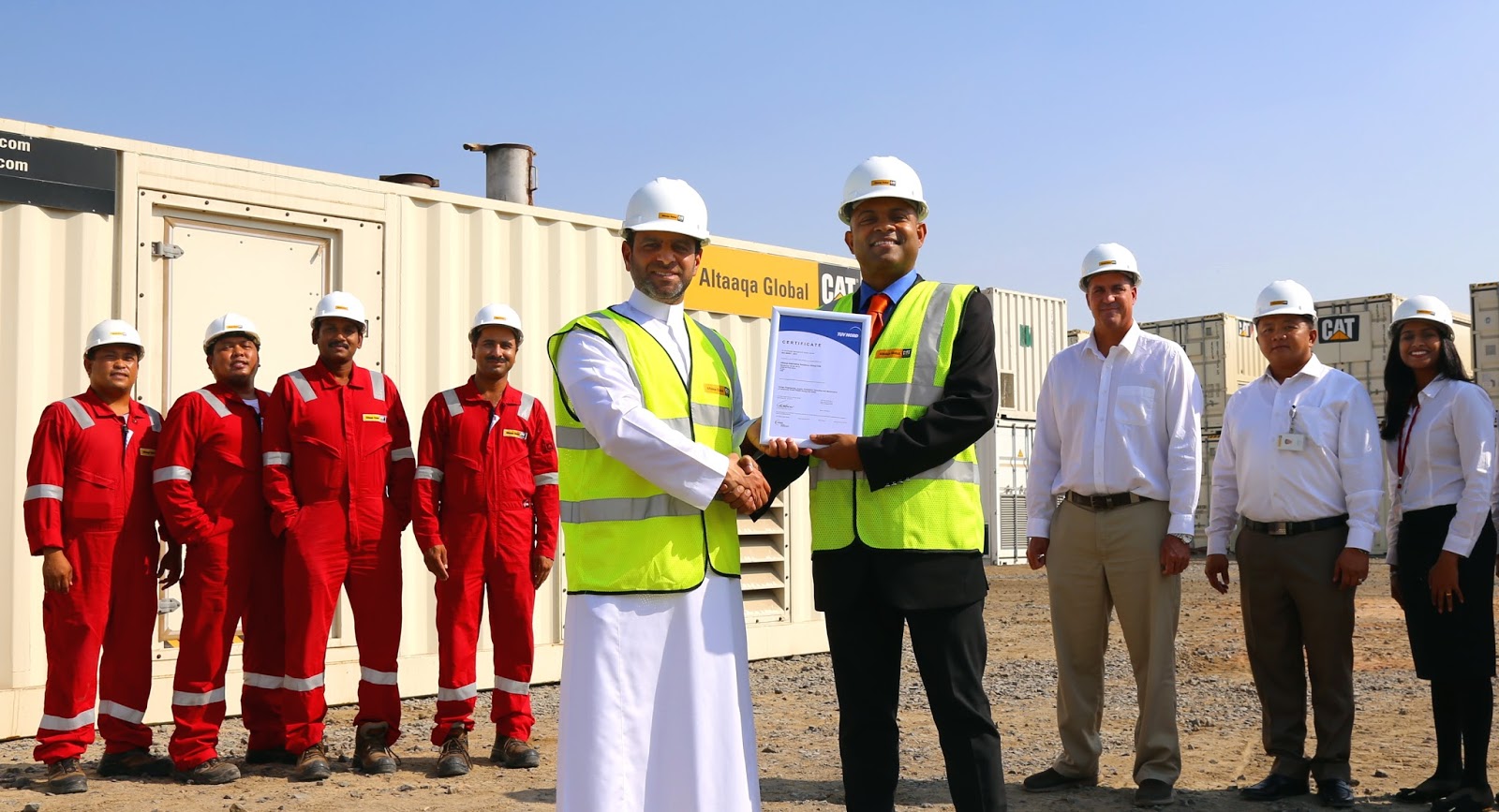
La empresa es la primera y, hasta el momento, la única proveedora de energía temporal en lograr la certificación de sus proyectos de conformidad con las normas ISO 50001:2011 

Después de meses de una rigurosa alineación de procesos y una auditoría extensiva, Altaaqa Global Caterpillar Rental Power, un proveedor mundial líder de soluciones de energía temporal de multimegavatios, obtuvo la certificación ISO 50001:2011 de TÜV NORD, la organización de certificación acreditada por ISO con sede central en Hanover, Alemania.


ISO 50001:2011 especifica los requisitos para establecer, implementar, mantener y mejorar un sistema de gestión de energía, cuyo propósito es permitir a organización seguir un enfoque sistemático para lograr mejoras continuas en el desempeño energético dentro de sus operaciones y proyectos.

“ISO 50001:2011 es aplicable a todas las organizaciones que deseen garantizar que sus productos y servicios cumplan con su política de energía declarada”, afirmó Shibu Davies, Gerente General de Certificaciones, HSD & Lab en TÜV NORD. “La certificación concedida a Altaaqa Global, la única empresa de alquiler de energía del mundo en haber alcanzado la hazaña hasta la fecha, es testimonio de la firme dedicación de la empresa de ofrecer proyectos de generación de energía multimegavatios que utilicen la energía de manera eficiente, preserven los recursos naturales y ayuden a combatir el cambio climático”.

Meghana Millin, Responsable de Calidad y Medio Ambiente, Salud y Seguridad en Altaaqa Global, describió de qué manera la empresa garantiza la implementación y el cumplimiento de su política energética en sus procesos. “Capacitamos a nuestros objetivos sobre cómo ofrecer las soluciones energéticas más eficientes y ecológicas a nuestros clientes. Por lo tanto, continuamos comprometidos con nuestra política energética desde la selección de equipamiento eléctrico hasta el diseño de las centrales eléctricas, el transporte y la instalación, la puesta en marcha y el mantenimiento de los proyectos. Asimismo, actualizamos regularmente nuestras instalaciones actuales para mejorar aún más su desempeño energético”.

Majid Zahid, Director Comercial de Altaaqa Global, especificó de qué manera la empresa garantiza la satisfacción del cliente en todos sus proyectos de alquiler de energía multimegavatios: “Garantizamos que nuestras centrales eléctricas mantienen el máximo nivel de eficiencia mediante el control y la evaluación de su desempeño por parte de prestigiosos organismos de certificación mundiales. De esta manera, garantizamos a nuestros clientes que nuestros proyectos energéticos no solo suministran energía confiable e ininterrumpida, sino que también ofrecen ahorro de costos y mínimos gastos operativos”.

Respecto de este tema, Peter den Boogert, Director General de Altaaqa Global, instó al sector de energía de alquiler a defender la causa de la responsabilidad energética. “Al estar en el negocio del suministro de electricidad, la responsabilidad pesa sobre nosotros, los proveedores de energía temporal, de mitigar concienzudamente los efectos ambientales de nuestras operaciones. Es por eso que en Altaaqa Global desarrollamos y optimizamos continuamente nuestras soluciones de generación de energía para que, en última instancia, promuevan beneficios económicos, sociales y ambientales reales. Nos enorgullece haber marcado el camino en el desempeño energético y el rendimiento del combustible en el sector de productores independientes de energía”.

En 2014, Altaaqa Global también obtuvo las certificaciones ISO 9001:2008 (Sistema de Gestión de Calidad), ISO 14001:2004 (Sistema de Gestión Medioambiental) y OHSAS 18001:2007 (Sistema de Gestión de la Salud y la Seguridad en el Trabajo) y, por lo tanto, pasó a formar parte de una lista de élite de empresas mundiales que han completado una auditoría tripe y han recibido todas las certificaciones en su primer año de evaluación.

Fin

Acerca de Altaaqa Global
Altaaqa Global, filial de Zahid Group, ha sido seleccionada por Caterpillar Inc. para proporcionar soluciones energéticas temporales de múltiples MW de llave en mano a nivel mundial. La empresa posee, moviliza, instala y maneja eficaces plantas energéticas independientes (IPP) temporales en emplazamientos de clientes, con una concentración en los mercados emergentes de África Subsahariana, Asia Central, el subcontinente indio, América Latina, Asia Sudoriental, Oriente Medio y África del Norte. Altaaqa Global, que ofrece equipos de alquiler para generación eléctrica que funcionan con diferentes tipos de combustible como diésel, gas natural o combustible dual, está posicionada para implementar y proporcionar rápidamente soluciones de plantas energéticas temporales que permiten suministrar electricidad en cualquier momento y lugar según sea necesario.

http://www.altaaqaglobal.com/press-media/press-releases


Acerca de Zahid Group
Zahid Group representa a una amplia variedad de empresas que ofrecen soluciones integrales orientadas al cliente en diversos sectores en crecimiento. Algunos de estos sectores son: minería; petróleo y gas; agricultura; generación de energía, electricidad y agua; manipulación de materiales; materiales de construcción; transporte y logística; desarrollo inmobiliario; turismo y viajes; reciclaje y gestión de desechos; y hotelería.

http://www.zahid.com/


Acerca de TÜV NORD
TÜV NORD International GmbH & Co. KG ha establecido relaciones comerciales en más de 70 países por toda Europa, América, Asia y África, y tiene representación en los mercados más grandes a nivel mundial. TÜV NORD Group ha combinado sus competencias reconocidas, su talento innovador versátil y muchas otras empresas líderes en sus segmentos de mercado bajo el auspicio de TÜV NORD International. Actualmente, los conocimientos técnicos desarrollados a lo largo de los años junto con una fuerza laboral de 8400 empleados a nivel mundial lograron que “TÜV NORD” sea aceptado como un nombre de confianza, capacidad, calidad y seguridad.


ATENCIÓN A LOS MEDIOS
Altaaqa Global
Tel.: +971 56 1749505
rbagatsing@altaaqaglobal.com

Altaaqa Global obtém reconhecimento ISO pelo desempenho energético

A empresa é o primeiro e, até agora, o único fornecedora de energia temporária a ter seus projetos certificados em conformidade com os padrões ISO 50001:2011 

Depois de meses de rigoroso alinhamento de processo e extensa auditoria, a Altaaqa Global Caterpillar Rental Power, fornecedor líder global de soluções de energia temporária multi-megawatt, obteve a certificação ISO 50001:2011 da TÜV NORD, o órgão certificador reconhecido pela ISO sediado em Hanover, na Alemanha.


A ISO 50001:2011 especifica os requisitos para estabelecer, implementar, manter e aprimorar um sistema de gerenciamento de energia cujo objetivo é permitir que uma organização siga uma abordagem sistemática para obter aprimoramento contínuo do desempenho energético em suas operações e projetos.

“A ISO 50001:2011 é aplicável a qualquer organização que deseja garantir que seus produtos e serviços estejam em conformidade com sua política energética declarada”, afirmou Shibu Davies, Diretor Geral de Certificação, HSD & Lab, da TÜV NORD. “Essa certificação concedida à Altaaqa Global, a única empresa de fornecimento de energia do mundo a ter realizado esse feito até agora, é um testemunho da dedicação inabalável da empresa em entregar projetos de geração energética multi-megawatt que utilizam energia de modo eficiente, preservem os recursos naturais e ajudem a combater as mudanças climáticas.”

Meghana Millin, Diretora de Qualidade e Serviço de Saúde da Altaaqa Global, descreveu como a empresa garante que sua política de energia seja implementada e respeitada em todos os processos. “Nós treinamos nossa visão para oferecer as soluções mais energeticamente eficientes e ambientalmente responsáveis a nossos clientes. Assim, permanecemos comprometidos com nossa política de energia em todos os momentos: na escolha do equipamento de energia, no desenvolvimento das usinas, no transporte, na instalação do projeto, no comissionamento e na manutenção. Além disso, atualizamos regularmente nossas instalações para aprimorar ainda mais seu desempenho energético.”

Majid Zahid, Diretor Comercial da Altaaqa Global, explicou como a empresa garante a satisfação do cliente em todos os seus projetos de fornecimento de energia multi-megawatt: “Nos certificamos de que nossas usinas mantenham o mais alto nível de eficiência, fazendo com que seu desempenho seja monitorado e avaliado por órgãos de certificação globais. Dessa maneira, garantimos aos clientes que nossos projetos de energia não apenas forneçam eletricidade confiável ininterrupta, mas também ofereçam economia e despesas operacionais mínimas.”

Em relação a essa última parte, Peter den Boogert, CEO da Altaaqa Global, convida o setor de fornecimento de energia elétrica a se dedicar à causa da responsabilidade energética. “Estando no ramo de fornecimento de energia, recai sobre nós, fornecedores de energia temporária, a responsabilidade de reduzir conscientemente os impactos ambientais de nossas operações. É por isso que nós, da Altaaqa Global, desenvolvemos e otimizamos continuamente nossas soluções de geração de energia, promovendo, por fim, reais benefícios econômicos, sociais e ambientais. Temos orgulho de ser pioneiros no desempenho energético e na eficiência de combustível no setor de Política de Produtos Integrada.”

Em 2014, a Altaaqa Global também obteve as certificações ISO 9001:2008 (Sistema de Gerenciamento de Qualidade), ISO 14001:2004 (Sistema de Gerenciamento Ambiental) e OHSAS 18001:2007 (Sistemas de Gerenciamento de Segurança e Saúde Ocupacional), tornando-se parte da lista de elite de empresas mundiais que concluíram uma auditoria tripla e receberam todas as certificações em seu primeiro ano de avaliação.


Fim


Sobre a Altaaqa Global
A Altaaqa Global, uma subsidiária do Grupo Zahid, foi selecionada pela Caterpillar Inc. para distribuir soluções elétricas completas e temporárias de muitos megawatts em todo o mundo. A companhia possui, mobiliza, instala e opera centrais elétricas eficientes independentes temporárias (IPP) nas localizações do cliente, focando-se nos mercados emergentes da África Subsaariana, Ásia Central, Subcontinente Indiano, América Latina, Sudeste da Ásia, Médio Oriente e Norte de África. Disponibilizando equipamento de energia elétrica de aluguel que pode operar com tipos de combustíveis diferentes, tais como diesel, gás natural ou bicombustível, a Altaaqa Global está posicionada para instalar e implementar rapidamente soluções com centrais elétricas temporárias, fornecendo eletricidade sempre e onde quer que seja necessária.

http://www.altaaqaglobal.com/press-media/press-releases


Sobre o Grupo Zahid
O Grupo Zahid representa uma gama diversa de empresas, oferecendo soluções abrangentes e centradas no cliente em vários setores em expansão. Algumas dessas atividades incluem construção; mineração; petróleo e gás; agricultura; geração de energia, eletricidade e água; manuseio de materiais; materiais para construção; transporte e logística; desenvolvimento imobiliário; viagens e turismo; gestão de resíduos e reciclagem; e hospitalidade.

http://www.zahid.com/


Sobre a TÜV NORD
A TÜV NORD International GmbH & Co. KG tem relações comerciais estabelecidas em mais de 70 países na Europa, na América, na Ásia e na África e está representada agora em todos os principais mercados mundiais. O Grupo TÜV NORD reuniu sua competência reconhecida, seu talento inovador e versátil e diversas empresas que são líderes em seus segmentos de mercado sob o controle geral da TÜV NORD International. Hoje, o know-how desenvolvido com o passar de vários anos e uma dedicada e forte equipe de trabalho de mais de 8.400 funcionários em todo o mundo garantem que a “TÜV NORD” seja vista como um nome mundial quando se trata de segurança, qualidade, competência e confiança.


INFORMAÇÕES À IMPRENSA
Altaaqa Global
Tel: +971 56 1749505
rbagatsing@altaaqaglobal.com

Sunday, February 19, 2017

Altaaqa Global obtient la certification ISO pour sa performance en solutions d’énergie

L’entreprise est le premier et l’unique prestataire de solutions d’énergie temporaire dont les projets sont certifiés par la norme ISO 50001:2011 

Après de nombreux mois d’audits détaillés et d’alignements des processus rigoureux, Altaaqa Global Caterpillar Rental Power, le principal prestataire international de solutions d’énergie temporaire de plusieurs méga-watts, a obtenu la certification ISO 50001:2011 auprès de TÜV NORD, l’organisme de certification ISO siégeant à Hanovre en Allemagne.


La norme ISO 50001:2011 détermine les exigences relatives à l’établissement, l’exécution, l'entretien et l’amélioration d’un système de gestion de l’énergie dont le but est de permettre à une organisation de suivre une approche systématique visant à améliorer en continu la performance énergétique au sein de ses projets et opérations.

« La norme ISO 50001:2011 s’applique à toutes les organisations qui veulent s’assurer que leurs produits et services respectent leurs politiques énergétiques officielles », indique Shibu Davies, directeur général Certification, HSD & Lab chez TÜV NORD. « Cette certification attribuée à Altaaqa Global, la seule entreprise de location d’énergie au monde à accomplir, jusqu’à présent, cette prouesse, témoigne de l’engagement résolu de cette entreprise à délivrer des projets de génération d’énergie de plusieurs méga-watts qui utilisent efficacement l’énergie, préservent les ressources naturelles et aident à combattre le changement climatique. »

Meghana Millin, responsable qualité & HSE chez Altaaqa Global, a décrit comment l’entreprise veille à la bonne exécution et au respect de sa politique énergétique à travers tous ses processus. « Nous faisons notre possible pour fournir des solutions d’énergie aussi écologiques et écoénergétiques que possible à nos clients. Nous respectons notre politique énergétique depuis la sélection de l’équipement énergétique, en passant par la conception des centrales, jusqu’au transport, l’installation, la mise en service et la maintenance du projet. En outre, nous actualisons régulièrement nos installations pour améliorer encore plus leur performance énergétique. »

Majid Zahid, le directeur commercial d’Altaaqa Global, a expliqué comment l’entreprise garantit la satisfaction de ses clients dans tous ses projets de location d’énergie de plusieurs méga-watts : « Nous veillons à ce que nos centrales soient aussi performantes que possible au travers de contrôles et d’évaluations par des organismes internationaux reconnus. Ainsi, nous pouvons garantir à nos clients que non seulement nos projets pourront leur fournir, en toute fiabilité et en continu, de l’électricité mais également qu'ils leur offriront des économies de coûts et des dépenses d’exploitation aussi minimes que possible. »

Pour sa part, Peter den Boogert, PDG d’Altaaqa Global, demande à l'industrie de la location d’énergie de soutenir la cause qui promeut la responsabilité énergétique. « Parce que nous sommes dans l'industrie de la fourniture d’énergie il nous incombe à nous, fournisseurs d’énergie temporaire, d’amoindrir en toute conscience l'impact environnemental de nos opérations. C’est la raison pour laquelle, chez Altaaqa Global, nous cherchons constamment à développer et à optimiser nos solutions de génération d’énergie pour qu’elles promeuvent, au final, de vrais avantages pour l’environnement, l’économie et la société. Nous sommes fiers d’avoir ouvert la voie à la performance et au rendement énergétiques dans l’industrie des producteurs d’énergie autonomes. »

En 2014, Altaaqa Global a également obtenu les certifications ISO 9001:2008 (Système de gestion de la qualité), ISO 14001:2004 (Système de gestion de l’environnement) et OHSAS 18001:2007 (Systèmes de gestion de la santé et de la sécurité au travail), faisant d’elle un membre de l’élite des entreprises internationales ayant effectué un triple audit et ayant reçu toutes les certifications dans sa première année d’évaluation.


Fin


À propos d'Altaaqa Global
Altaaqa Global, filiale du groupe Zahid, a été choisie par Caterpillar Inc. pour livrer des solutions d'alimentation électrique temporaire clé en main de plusieurs mégawatts dans le monde entier. L'entreprise possède, mobilise, installe et opère des centrales électriques indépendantes (CEI) temporaires et efficaces sur les sites de ses clients, et se concentre sur les marchés émergents de l'Afrique sub-saharienne, de l'Asie centrale, du sous-continent indien, de l'Amérique latine, de l'Asie du sud-est, du Moyen-Orient et de l'Afrique du nord. Proposant à la location des équipements électriques fonctionnant sur divers carburants tels que le diesel, le gaz naturel ou des carburants mixtes, Altaaqa est en mesure de déployer et de livrer rapidement des solutions de centrales électriques temporaires, fournissant de l'électricité à l'endroit et au moment où celle-ci est requise.

http://www.altaaqaglobal.com/press-media/press-releases


À propos du groupe Zahid
Le groupe Zahid représente un large éventail d'entreprises qui offrent des solutions complètes axées sur le client dans de nombreux secteurs en pleine expansion. Parmi eux, on compte : le secteur minier, le secteur pétrolier et gazier, l'agriculture, l'énergie, la production d'électricité, la manutention, les matériaux de construction, les transports et la logistique, la promotion immobilière, le voyage et le tourisme, la gestion des déchets et le recyclage, et l'hôtellerie.

http://www.zahid.com/


À propos de TÜV NORD
TÜV NORD International GmbH & Co. KG entretient des relations professionnelles bien établies dans plus de 70 pays en Europe, dans les Amériques, l'Asie et l'Afrique et est aujourd'hui présente sur tous les grands marchés mondiaux. Le groupe TÜV NORD associe ses compétences reconnues, son talent innovant et polyvalent ainsi que de nombreuses entreprises chefs de file dans leur segment de marché sous l'égide de TÜV NORD International. Aujourd'hui, grâce au savoir-faire développé au cours de nombreuses années et à un personnel dédié de 8 400 employés, "TÜV NORD" est synonyme de sécurité, qualité, compétence et confiance sur le marché mondial.


CONTACT PRESSE
Altaaqa Global
Tel: +971 56 1749505

Saturday, February 18, 2017

Caterpillar Named One of Fortune's World's Most Admired Companies in 2017

As part of the Caterpillar family, we at Altaaqa Global are proud to announce that Caterpillar has once again been named as one of Fortune's World's Most Admired Companies in 2017!

Here is the official release from Caterpillar: 

We are proud to be named to Fortune’s World’s Most Admired Companies® 2017 list. This year, Caterpillar is ranked number 47. Caterpillar has appeared in the Top 50 All-Stars list for 16 consecutive years.


Fortune also ranked Caterpillar as the number one most admired company in the Construction and Farm Machinery category. Caterpillar has appeared in Fortune’s industry rankings every year since 1998 -- and this is the third year in a row that we've been ranked number one.               
         

To determine the best-regarded companies within each industry, the global management consulting firm Korn Ferry Hay Group asked 3,800 executives, directors and securities analysts to rate companies within their own industry on nine criteria, including innovation, social responsibility, and global competitiveness.

To determine the Top 50 All-Stars, Korn Ferry Hay Group asked the respondents to select the 10 companies they admired most. Unlike with the industry rankings, respondents could pick any company in any industry while selecting their top 10 companies. We're honored to have been included in many respondents' top 10 lists.

Visit fortune.com to see the full list of the World’s Most Admired Companies.

Here is the link to the original article: https://goo.gl/gvtE9m


Ends


PRESS INQUIRIES
Altaaqa Global
Tel: +971 56 1749505

rbagatsing@altaaqaglobal.com