As part of the Caterpillar family, we at Altaaqa Global are proud to announce that Caterpillar has once again been named as one of Fortune's World's Most Admired Companies in 2017!
Here is the official release from Caterpillar:
We are proud to be named to Fortune’s World’s Most Admired Companies® 2017 list. This year, Caterpillar is ranked number 47. Caterpillar has appeared in the Top 50 All-Stars list for 16 consecutive years.
Fortune also ranked Caterpillar as the number one most admired company in the Construction and Farm Machinery category. Caterpillar has appeared in Fortune’s industry rankings every year since 1998 -- and this is the third year in a row that we've been ranked number one.
To determine the best-regarded companies within each industry, the global management consulting firm Korn Ferry Hay Group asked 3,800 executives, directors and securities analysts to rate companies within their own industry on nine criteria, including innovation, social responsibility, and global competitiveness.
To determine the Top 50 All-Stars, Korn Ferry Hay Group asked the respondents to select the 10 companies they admired most. Unlike with the industry rankings, respondents could pick any company in any industry while selecting their top 10 companies. We're honored to have been included in many respondents' top 10 lists.
Visit fortune.com to see the full list of the World’s Most Admired Companies.
Here is the link to the original article: https://goo.gl/gvtE9m
Ends
PRESS INQUIRIES
Altaaqa Global
Tel: +971 56 1749505
rbagatsing@altaaqaglobal.com
Showing posts with label innovation. Show all posts
Saturday, February 18, 2017
Tuesday, November 1, 2016
Pros and Cons of Different Fuel Options for Power Plants
In our previous article, we discussed lifecycle costs associated with the operation and maintenance of power plants, be they temporary or permanent. We said that though fuel represented the highest lifecycle cost, it was also the easiest to predict and calculate. In this article, we will look into some of the fuel options available for power plants, and identify some of their advantages and disadvantages.
Different fuel options are important in designing systems that respond to individual energy needs, budget concerns and fuel availability. Each fuel type has its benefits and drawbacks, so it is essential to take some time and research on the best fuel option during the system design process. Some fuel options available include natural gas, diesel, HFO and renewable fuels, such as vegetable oils, animal fats, and bio-diesel.
Natural gas is gaining ground as a cost-effective fuel solution, because it burns cleaner, and lengthens maintenance intervals and component lifetimes. There are multi-megawatt temporary power plants composed of natural gas generators that are designed for low-emission operation and fast set-up. Running on natural gas, these generators comply with worldwide emission limits even without after-treatment. Some observed disadvantages of natural gas are its limited availability and high costs of installing safe and reliable fuel delivery infrastructure. These, however, are gradually being solved owing to the increasing availability of gas and the opportunities in bigger and longer-duration projects opening up for gas power plants.
Diesel’s trump card has always been its availability, safety and economy, and ease of installation of power generation systems running on diesel. Diesel power generation systems are known to be reliable and flexible and are equipped with state-of-the-art technologies that allow them to run on a variety of fuels. Some noted disadvantages of using diesel as a fuel are the observed fluctuation of its price and environmental stewardship issues. The good news is that with cutting-edge power technologies made available by global temporary power providers, these observed issues can be mitigated.
Heavy fuel oil or HFO is available worldwide and engines running on this fuel are relatively common, but HFO has been observed to contain contaminants that increase component wear. Recognizing this, temporary power plant providers are making sure that they have intermediate systems that refine the fuel, reducing the contaminants and further enhancing the quality of the fuel. When choosing a power partner to run an HFO power plant, it is vital to make sure that the provider has these technologies available in order to lower the chances of reduced component life and higher maintenance costs.
Dual-fuel engines are another option to be considered. Though these engines are observed to have higher initial costs compared to single-fuel engines, they have the capability to provide the high-level of fuel flexibility that operators specifically require. Global temporary power providers can offer bi-fuel technologies that are specifically engineered to reduce fuel costs. For instance, there is a technologically advanced power system that uses a combination of 70% gas and 30% diesel, which will have a positive impact not only on fuel costs but also on emissions.
Alternative, reliable fuel options like vegetable oils, animal fats, and bio-diesel can also be utilized, but these require fuel treatment equipment. It may be helpful to note that the additional equipment may increase the initial capital costs and maintenance costs.
Different fuels have characteristics that influence their applicability. Depending on the location, budget, energy requirements or available technology, one fuel may be preferred over another. Experts say that it is still best to go with the clean fuel option, as this will result in longer component life and less performance degradation. But, thanks to the cutting-edge auxiliary technologies introduced in today’s power generation technologies, even the less clean fuels become viable options in specific situations.
PRESS INQUIRIES
Altaaqa Global
Tel: +971 56 1749505
rbagatsing@altaaqaglobal.com
Different fuel options are important in designing systems that respond to individual energy needs, budget concerns and fuel availability. Each fuel type has its benefits and drawbacks, so it is essential to take some time and research on the best fuel option during the system design process. Some fuel options available include natural gas, diesel, HFO and renewable fuels, such as vegetable oils, animal fats, and bio-diesel.
Natural gas is gaining ground as a cost-effective fuel solution, because it burns cleaner, and lengthens maintenance intervals and component lifetimes. There are multi-megawatt temporary power plants composed of natural gas generators that are designed for low-emission operation and fast set-up. Running on natural gas, these generators comply with worldwide emission limits even without after-treatment. Some observed disadvantages of natural gas are its limited availability and high costs of installing safe and reliable fuel delivery infrastructure. These, however, are gradually being solved owing to the increasing availability of gas and the opportunities in bigger and longer-duration projects opening up for gas power plants.
Diesel’s trump card has always been its availability, safety and economy, and ease of installation of power generation systems running on diesel. Diesel power generation systems are known to be reliable and flexible and are equipped with state-of-the-art technologies that allow them to run on a variety of fuels. Some noted disadvantages of using diesel as a fuel are the observed fluctuation of its price and environmental stewardship issues. The good news is that with cutting-edge power technologies made available by global temporary power providers, these observed issues can be mitigated.
Heavy fuel oil or HFO is available worldwide and engines running on this fuel are relatively common, but HFO has been observed to contain contaminants that increase component wear. Recognizing this, temporary power plant providers are making sure that they have intermediate systems that refine the fuel, reducing the contaminants and further enhancing the quality of the fuel. When choosing a power partner to run an HFO power plant, it is vital to make sure that the provider has these technologies available in order to lower the chances of reduced component life and higher maintenance costs.
Dual-fuel engines are another option to be considered. Though these engines are observed to have higher initial costs compared to single-fuel engines, they have the capability to provide the high-level of fuel flexibility that operators specifically require. Global temporary power providers can offer bi-fuel technologies that are specifically engineered to reduce fuel costs. For instance, there is a technologically advanced power system that uses a combination of 70% gas and 30% diesel, which will have a positive impact not only on fuel costs but also on emissions.
Alternative, reliable fuel options like vegetable oils, animal fats, and bio-diesel can also be utilized, but these require fuel treatment equipment. It may be helpful to note that the additional equipment may increase the initial capital costs and maintenance costs.
Different fuels have characteristics that influence their applicability. Depending on the location, budget, energy requirements or available technology, one fuel may be preferred over another. Experts say that it is still best to go with the clean fuel option, as this will result in longer component life and less performance degradation. But, thanks to the cutting-edge auxiliary technologies introduced in today’s power generation technologies, even the less clean fuels become viable options in specific situations.
End
Reference:
Steffens, David. “Lifecycle Cost Considerations when Choosing a Power Generation System”. Caterpillar Power Generation Systems. February 2013.
Altaaqa Global
Tel: +971 56 1749505
rbagatsing@altaaqaglobal.com
Labels:
Altaaqa Global,
Bi-fuel,
diesel,
dual-fuel,
electricity,
energy,
engineering,
gas,
generator,
genset,
HFO,
innovation,
mobile,
power,
rent,
rental,
technology,
temporary
Wednesday, July 13, 2016
Altaaqa Global is Hiring!
Altaaqa Global, a leading global provider of temporary power solutions, is currently hiring for the following positions:
Business Development Director – Sub-Saharan Africa
Based in Johannesburg, South Africa
Reporting to the Chief Executive Officer
The Business Development Director is responsible for growing the companies revenue and profits in Africa through Interim IPP (International Power Projects) opportunities at margins and returns agreed within our strategy and group procedures & policies. He/she should ideally have a track record of successfully identifying, negotiating and executing complex deals, preferably in Africa. Experience and knowledge in conducting business in African countries, and knowledge of power generation is desirable.
Reporting to Regional Business Development Director
The Sales Engineer for MENA is responsible for directly selling the company´s products or services to customers. He/she should develop new accounts and/or expand existing ones within an established geographic territory, industry, product segment or international project. He/she should work on complex issues where analysis of situations, market intelligence or data require an in-depth evaluation of variable factors. He/she should be responsible for timely follow up of all request for quotations either by tenders or by customers’ request.
Sales Manager for Southern Africa
Sales Manager for West Africa
Business Development Director – Sub-Saharan Africa
Based in Johannesburg, South Africa
Reporting to the Chief Executive Officer
The Business Development Director is responsible for growing the companies revenue and profits in Africa through Interim IPP (International Power Projects) opportunities at margins and returns agreed within our strategy and group procedures & policies. He/she should ideally have a track record of successfully identifying, negotiating and executing complex deals, preferably in Africa. Experience and knowledge in conducting business in African countries, and knowledge of power generation is desirable.
Interested parties may submit their CVs to career@altaaqaglobal.com.
Please include the code SSBD in the subject of your e-mail.
Sales Engineer for Middle East and North Africa (MENA)
Based in Dubai, United Arab EmiratesPlease include the code SSBD in the subject of your e-mail.
Sales Engineer for Middle East and North Africa (MENA)
Reporting to Regional Business Development Director
The Sales Engineer for MENA is responsible for directly selling the company´s products or services to customers. He/she should develop new accounts and/or expand existing ones within an established geographic territory, industry, product segment or international project. He/she should work on complex issues where analysis of situations, market intelligence or data require an in-depth evaluation of variable factors. He/she should be responsible for timely follow up of all request for quotations either by tenders or by customers’ request.
Interested parties may submit their CVs to career@altaaqaglobal.com.
Please include the code SMSA in the subject of your e-mail.
Sales Manager for Southern Africa
Based in Johannesburg, South Africa
Reporting to the Business Development Director for Sub-Saharan Africa
The Sales Manager for Southern Africa is responsible for directly selling the company´s products or services to customers. He/she should develop new accounts and/or expand existing ones within an established geographic territory, industry, product segment or international project. He/she should work on complex issues where analysis of situations, market intelligence or data require an in-depth evaluation of variable factors. He/she should be responsible for timely follow up of all request for quotations either by tenders or by customers’ request.
Interested parties may submit their CVs to career@altaaqaglobal.com.
Please include the code SMWA in the subject of your e-mail.
Sales Manager for West Africa
Based in Accra, Ghana
Reporting to the Business Development Director for Sub-Saharan Africa
The Sales Manager for West Africa is responsible for directly selling the company´s products or services to customers. He/she should develop new accounts and/or expand existing ones within an established geographic territory, industry, product segment or international project. He/she should work on complex issues where analysis of situations, market intelligence or data require an in-depth evaluation of variable factors. He/she should be responsible for timely follow up of all request for quotations either by tenders or by customers’ request.
Interested parties may submit their CVs to career@altaaqaglobal.com.
Please include the code SMMENA in the subject of your e-mail.
Best of luck!
Labels:
Africa,
Altaaqa Global,
Career,
Director,
energy,
engineer,
Growth,
Hiring,
innovation,
Job,
Leadership,
Manager,
Middle East,
Opening,
Opportunity,
power,
Sales
Saturday, January 9, 2016
The Story of SALt: Sustainable Alternative Lighting
In the hope of alleviating the situation of their
countrymen, a group of Filipinos, led by Engr Aisa Mijeno, invented a lamp that
runs on just one glass of water and two tablespoons of salt. The inventors say
that the lamp, aptly called SALt, can work for up to eight hours, and has a lifespan of
approximately six months. When used for less hours, the lamp can last up to
more than a year.
SALt can also run on ocean water, which will be
particularly beneficial to people living along the coastline.
The inventors explain that there are no materials or
components inside the lamp that may cause fire accidents – in contrast with
kerosene lamps and candles that are hazardous and risky to health. “SALt,”
explained the inventors, “uses the science behind the Galvanic cell, which is
the basis for battery-making. It changes the electrolytes to a non-toxic,
saline solution, making the entire process safe and harmless.”
As an added feature, the lamp doubles up as an emergency charger for mobile phones. With the Philippines being the 3rd most disaster prone area in the world, it is highly essential for its residents to have a steady supply of food, drinking water, sustainable lighting and a stable means of communication during times of calamities.
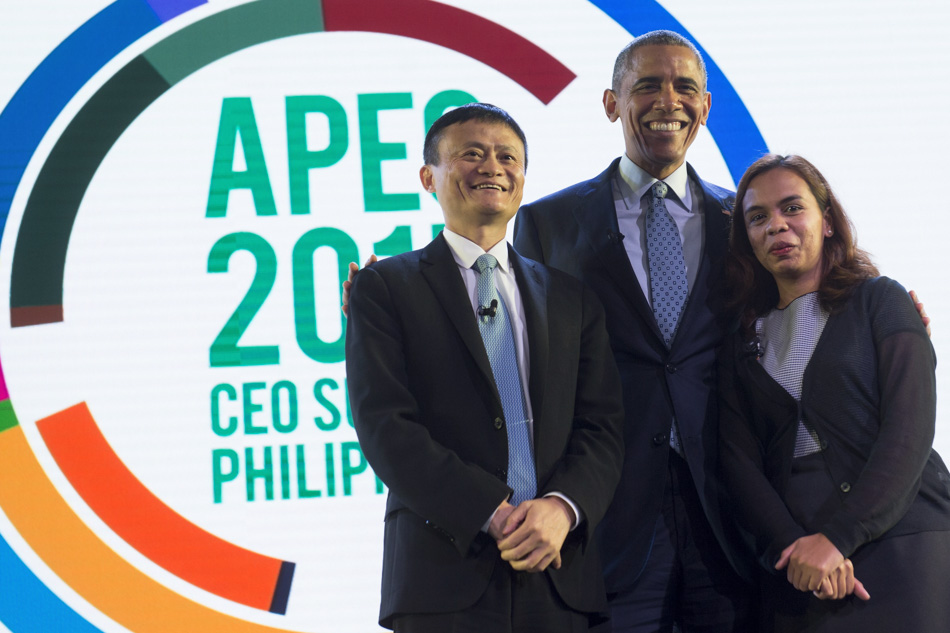
Interacting with US President Barack Obama and Alibaba Founder Jack Ma
From the ripples that SALt had been organically creating in the islands of the Philippines, it created a huge wave in an international convention of world leaders.
During the recently concluded APEC Summit in the Philippines, Engr Mijeno had the privilege of sitting in the same plenary session as US President Obama and Chinese billionaire, Alibaba founder Jack Ma. Mijeno said that it was the White House who invited her to join the session, spurred by its interest to know more about SALt. "We received a call from the White House," said Engr Mijeno, "which at first we thought was a prank call." She said she was invited to the session to represent female entrepreneurs and to talk to President Obama about start-up ventures in the Philippines that the US government could support.
During the dialogue with Obama, Mijeno took the chance to solicit support from the US President. The SALt inventor also revealed that Jack Ma also offered assistance, not divulging any details.
For more information on the lamp, visit: http://www.salt.ph
End
PRESS INQUIRIES
Altaaqa Global
Tel: +971 56 1749505
Wednesday, December 17, 2014
Altaaqa Global, Altaaqa替代解决方案在2014年MEPO颁奖典礼上荣获大奖
获年度健康和安全机构殊荣
姐妹公司当选年度专业承包商
姐妹公司当选年度专业承包商
总部位于迪拜的临时电力解决方案全球供应商Altaaqa Global及其总部位于沙特阿拉伯的姐妹公司,领先电力、水利和临时控制解决方案供应商,Altaaqa替代解决方案(Altaaqa),在2014年11月26日于索菲特迪拜棕榈岛水疗度假村举行的2014年MEP颁奖典礼上获多项大奖。Altaaqa Global凭借其杰出的恶劣条件下人力资源和设备部署的健康、安全和保障方案荣获大奖,同时总部位于吉达的Altaaqa替代解决方案赢得了年度专业承包商奖,该公司在沙特阿拉伯阿尔卡吉成功完成了95
MW临时发电厂项目,仅耗时22天。
Altaaqa Global在众多提名公司之中脱颖而出,这些公司包括ETA Engineering, Arabian MEP
Contracting, Mercury MENA, AECOM和ALEMCO。Altaaqa击败了多个入围企业,包括Arabian MEP
Contracting和SEMCO。
年度健康和安全倡议奖所奖励的是在自己的项目地点遵守并改善健康和安全标准,取得杰出成就的公司,或者开展特别培训或认识提升项目的公司。德高望重的评委团一致认为,Altaaqa Global题为“在恶劣环境中提供充足的安全保障”的参赛项目展示了通过制定详细的风险评估项目计划,即使在交付要求高度严苛的情况下也能够确保人身安全。
在问到对公司近期所取得功绩的评价时,Altaaqa Global常务董事Peter den Boogert如是说:“能得到地区最有威望和最受尊重的出版物之一颁发的奖项,我们感到自豪,同时也感到荣幸。毫无疑问,大奖奖励的是Altaaqa Global辛勤工作的员工,他们承受住了公司运营地区的安全不稳定性和恶劣的气候环境。我们所获的大奖也属于当地工程师,以及帮助我们内部团队在发电厂所在地保持安全和环境管理最高标准的保安及健康、安全和环境机构。”
另外一项大奖是年度专业承包商奖,奖励在移动电力行业当前发展中起到关键作用的公司,以及通过促进可持续发展和成本效益,帮助移动电力行业同全球其他行业看齐的公司。评委们高度称赞具历史意义的22天内竣工的沙特阿拉伯阿尔卡吉95
MW发电厂项目。他们认为Altaaqa展示了高度的协作和计划水平,凭借评委们所赞誉的“钢铁般的意志”,能够完成具有高度挑战性的任务。
Altaaqa执行董事Emad Mukhalataty在颁奖仪式上说道:“这一大奖将进一步鼓舞Altaaqa整个团队,激励他们继续向客户提供超出预期的创新和高质量的解决方案。”
Steven Meyrick代表Altaaqa Global和Altaaqa替代解决方案的董事会评价说,这一认可将激励两家公司进一步改善流程,继续勇于承接挑战工程极限的项目,同时探索健康和安全领域的创新性最佳实践。
Majid Zahid代表公司的母公司扎西德集团发言表示,相关个人及国家政府将提供急需的关键电力这一任务托付给集团旗下公司,集团同他们分享这一荣耀。“尽管我们的几个项目在极其恶劣的环境中开展,在真主阿拉的保佑下,我们的团队获得了不断保持卓越的力量,为人们提供了一流的电厂。我们将不断保持为各个地区、城市和公司供电,他们都是全球发展的关键推动者。”
完
关于Altaaqa Global
Altaaqa Global是扎西德集团旗下的子公司,被卡特彼勒公司选中,在全球范围内提供多兆瓦级交钥匙临时电力解决方案。公司在客户指定地点建立临时的独立发电厂(IPP),整个工程的调动、安装和操作都由Altaaqa Global完成,建成的发电厂也归Altaaqa Global所有。公司现在重点关注撒哈拉以南的非洲、中亚、印度次大陆、拉丁美洲、东南亚、中东和北非的新兴市场。公司还提供以不同燃料为基础的电力租赁设备,燃料种类包括柴油、天然气或双燃料,还能够提供并迅速部署临时发电厂解决方案,在需要的任何时间和地点提供电力。
关于扎西德集团
扎西德集团代表了一系列多元化的公司,为多个蓬勃发展的行业提供全面、以客户为中心的解决方案。这些行业包括建筑、矿业、石油和天然气、农业、能源、电力和水力发电、物料运输、建筑材料、交通和物流、房地产开发、旅游观光以及酒店业。
新闻咨询
Robert Bagatsing
Altaaqa Global
电话:+971 56 1749505
读者请求
Altaaqa Global
Marketing Department
P.O.Box 262989
迪拜,阿联酋
Labels:
Altaaqa Global,
Award,
Blackout,
electricity,
emergency,
energy,
generator,
genset,
Health,
hire,
innovation,
load shedding,
MEP,
mobile,
Outage,
peak shaving,
power,
rental,
safety,
temporary
Wednesday, August 20, 2014
Keeping the power rolling
It was in 2010 when the idea of an “empowered” ball was
first documented. Four Harvard graduates conceptualized a soccer ball infused
with a pendulum-like mechanism that would rotate to power a generator, which
would then charge a battery inside the ball. This essentially meant that after
30 minutes of playing with the ball, it would already be capable of powering an
LED light bulb for several hours, and that a two-hour game would allow the ball
to charge a cell phone.
It is easy to infer that the ball was primarily created
with the aim of solving one of the world’s most daunting challenges: Billions
around the world do not have regular, reliable access to electricity. One of
the proponents, who come from an African descent, would often recount in
interviews the energy challenges she would face when she would visit her
grandmother’s home in Nigeria. The thought that many children in the world’s
most underdeveloped communities still suffer from playing under a single
lamppost or from studying beside a dangerous kerosene lamp drove the exponents to
take the technology further. With a two-fold objective of giving school
children a means of recreation and a small-scale reliable supply of
electricity, the “empowered” ball was distributed in schools and to depressed rural
communities around the world.
From the foregoing, one thing is clear – the invention of
the electric ball is an effort towards rural electrification. While it may be
obvious that thousands, maybe millions of electric soccer balls are needed (not
to mention around hundreds of thousands of hours playing) to supply energy to
the entire population of the world without access to electricity, the traction
that the invention is gaining from investors and supporters around the world
represents a start towards the desired direction.
The
transformation of rural electrification
Electrification of rural communities has traditionally been
based on electricity supply from a central grid, mainly owing to the “economies
of scale” achieved with large-scale power plants. Recent technological advances
in alternative power sources, however, have made it sensible to consider
decentralized sources of energy, like photovoltaic systems, wind turbines,
biomass and fuel cells. Innovation in alternative sources of electricity is
further driven by local and international agreements reinforcing a reduction in
emissions, and a ramp-up in the efficiency of production and use of energy.
Research studies show that at present, more than ever, the
electrification of rural and remote communities in emerging countries will be
based on decentralized power facilities. But, as the demand for electricity grows as the population increases and as lifestyles evolve, rural
electrification activities should be designed and implemented within a precise
policy framework. Industry players find merit in using excess power generated
by rural industrial enterprises to support public electricity sully, and in
considering small-scale independent power producers fully fledged suppliers of
electricity. Energy industry authorities advocate a stringent cooperation
between utility providers and rural customers, as well as the adoption of a
well-defined marketing and technical function.
The fact that rural electricity supply is more expensive
relative to urban energy supply is often seen as a disadvantage by utility
providers. But, in light of the truth that billions of people are struggling
with the lack of access to dependable power, energy thought leaders say that
the predicament should be seen a challenge more than a bane. With the available
technological options and the growing support of transformative investors, industry
key players do not see a reason why rural electrification efforts should not be
carried forward.
*Watch
out for Part 2 of this article, where we will aim to take a close look at
critical success factors of rural electrification*
Media Contact:
Robert Bagatsing (Harvard SMM)
Marketing Manager
T: +971 4 8808006
M: +971 56 1749505
Skype:
Robert.Bagatsing
BBM: 25D309ED
Twitter:
@RobertBagatsing
Labels:
Altaaqa Global,
electricity,
generator,
Harvard,
innovation,
photovoltaic,
power plant,
rural electrification,
soccket ball,
socent,
social enterprise,
social good,
social impact,
socinn,
sustainability,
utility
Subscribe to:
Posts (Atom)