Showing posts with label Biomass. Show all posts

Monday, August 17, 2015

Do Renewable Energy Facilities Have a Negative Impact on the Environment?

Every year, the number of countries that pledge to incorporate renewable energy in their overall energy mix is gradually going up. Be they incited by a constantly increasing demand for electricity, a keen interest to augment electrification rates or by the desire to conform to strict efficiency and environmental stewardship standards, the plans to “go green” are projected to come into fruition in 10 to 20 years.


In recent years, the world has seen a notable increase in the number of constructed and in-progress renewable energy facilities. In 2014, 64% of the global installed renewable energy capacity is hydro, 24% is wind, 8% is solar, 3% is bioenergy and 1% is geothermal (www.altenergymag.com). The facilities are indubitably geared towards the amplification of energy reserves and the reduction of the environmentally harmful effects of conventional energy generation, but are such facilities really as friendly to the environment as they are billed to be?

We have investigated some of the negative effects of renewable energy facilities towards the environment, and here is what we found:

Hydro

Though hydropower facilities do not cause any direct air quality impact, their construction and operation can influence the flow of rivers, which, in turn, affects wildlife and people.

Hydro facilities can cause flooding in and around the area where they are situated. When the water stored within the dam is suddenly released, it can lead to immediate flooding of the river downstream. The flooding may result in the destruction of agricultural land and forests.

Wind

Wind energy facilities are mostly scrutinized due to their impact on birds and other species. A recent release from the National Wind Coordinating Committee reflects that collisions with wind turbines, and the change in air pressure owing to spinning turbines are responsible for a number of deaths among birds and bats.

Solar

Complaints about solar facilities are often motivated by issues in land use, water use, habitat loss and materials used in the manufacture of solar panels.

Case-in point, to build a large-scale power facility, a vast area of land is needed. Experts suggest that the use of many acres of land may result in clearing and grading of land, leading to soil compaction, erosion and alteration of drainage channels.

Solar energy systems can also negatively affect the land during the process of materials extraction, exploration, manufacturing and disposal.

Bioenergy

Bioenergy feedstock, and the way it is harvested, may not only impact land use but also contribute to global warming emissions. For instance, human and animal waste utilized to power engines may increase harmful methane emission.

In addition, using tree or tree products to create biomass requires vast forest lands to be cleared, which causes topical changes and damages animal habitat.

Geothermal  

Aside from being known as capital intensive, constructing geothermal facilities may cause poisonous gases to escape during the drilling of holes. Geothermal facilities are also, under extreme circumstances, known to cause earthquakes.

While renewable energy facilities bring about observed negative impacts to the environment, one cannot deny the fact that they make a considerable difference in reducing carbon emissions largely associated with conventional electricity generation, among other processes. The onus is now on the R&D sector, manufacturers, implementing agencies and governments to mitigate (or eradicate) the impact the above-mentioned harmful effects.

In Part 2 of this article, we will take a look at other alternative energy sources that can support the power demand while renewable energy technologies and infrastructure are enhanced and optimized.

PRESS INQUIRIES
Altaaqa Global
Tel: +971 56 1749505
rbagatsing@altaaqaglobal.com

Wednesday, September 17, 2014

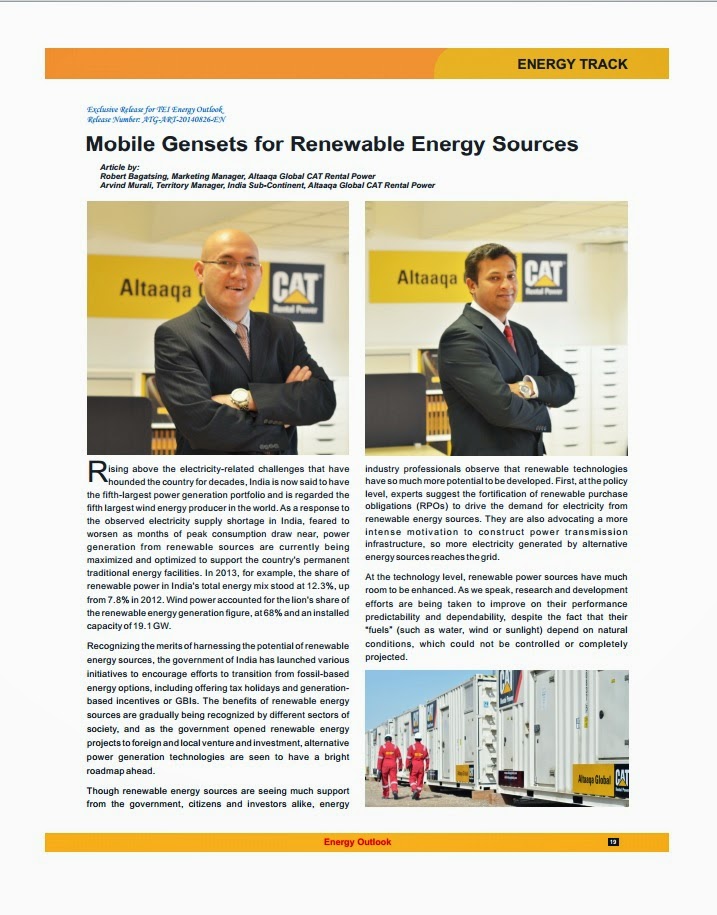
Mobile Gensets for Renewable Energy Sources

Rising above the electricity-related challenges that have hounded the country for decades, India is now said to have the fifth-largest power generation portfolio and is regarded the fifth largest wind energy producer in the world. As a response to the observed electricity supply shortage in India, feared to worsen as months of peak consumption draw near, power generation from renewable sources are currently being maximized and optimized to support the country’s permanent traditional energy facilities. In 2013, for example, the share of renewable power in India’s total energy mix stood at 12.3%, up from 7.8% in 2012. Wind power accounted for the lion’s share of the renewable energy generation figure, at 68% and an installed capacity of 19.1 GW.


Recognizing the merits of harnessing the potential of renewable energy sources, the government of India has launched various initiatives to encourage efforts to transition from fossil-based energy options, including offering tax holidays and generation-based incentives or GBIs. The benefits of renewable energy sources are gradually being recognized by different sectors of society, and as the government opened renewable energy projects to foreign and local venture and investment, alternative power generation technologies are seen to have a bright roadmap ahead.

Though renewable energy sources are seeing much support from the government, citizens and investors alike, energy industry professionals observe that renewable technologies have so much more potential to be developed. First, at the policy level, experts suggest the fortification of renewable purchase obligations (RPOs) to drive the demand for electricity from renewable energy sources. They are also advocating a more intense motivation to construct power transmission infrastructure, so more electricity generated by alternative energy sources reaches the grid.

At the technology level, renewable power sources have much room to be enhanced. As we speak, research and development efforts are being taken to improve on their performance predictability and dependability, despite the fact that their “fuels” (such as water, wind or sunlight) depend on natural conditions, which could not be controlled or completely projected.


As renewable technologies are being planned, constructed or augmented, and are still in diffusion to more communities and industrial areas in India, other alternative technologies can supplement them, bridging the gap in power supply and electricity demand. It has been documented that a 50 MW wind farm, for example, can be built in six months, and if one factors in the time needed for planning, designing, and receiving necessary approvals and permits, a wind farm may be operational after only a year or so. During the months when wind farms (or any other renewable energy facility for that matter) are not yet operational, mobile generator sets have the capacity to temporarily provide power to the communities planned to be beneficiaries of renewable energy.

Temporary generators are cost-effective immediate solution to power supply shortages and instability, which do not require a huge initial capital to acquire and install. Because rental gensets are modular and flexible, interim power stations can be installed in most places where renewable energy facilities find applications. Owing to their adaptive configuration, temporary gensets can be easily installed and commissioned, and can be run in as little time as a few days. Additionally, as they are containerized and have relatively small dimensions, mobile generators can be delivered from any point in the world to another.


With the support of temporary power plants, the perceived limitations of renewable sources of energy can be surmounted, and the deficit in supply of power can be filled. As renewable facilities ramp up their reliability and predictability, interim power stations can provide a viable and sustainable supply of power when needed and as needed by communities and industrial facilities in India. Alternative power sources, when enhanced and properly utilized, have the capacity to support permanent traditional sources of electricity to avoid further energy outages and load shedding, and to extend the coverage of the electricity supply even to the most remote communities and industries in India.


*The foregoing article was originally published in the September 2014 edition of The Energy Outlook, India.*

End

PRESS INQUIRIES
Robert Bagatsing
Altaaqa Global
Tel: +971 56 1749505
rbagatsing@altaaqaglobal.com