Showing posts with label Provisional. Show all posts

Wednesday, September 17, 2014

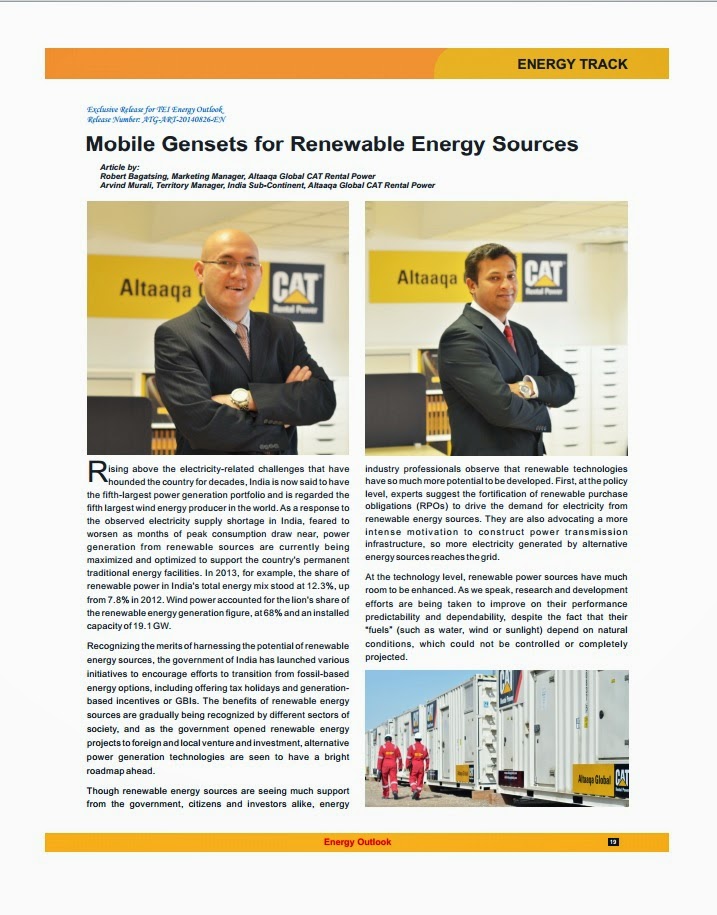
Mobile Gensets for Renewable Energy Sources

Rising above the electricity-related challenges that have hounded the country for decades, India is now said to have the fifth-largest power generation portfolio and is regarded the fifth largest wind energy producer in the world. As a response to the observed electricity supply shortage in India, feared to worsen as months of peak consumption draw near, power generation from renewable sources are currently being maximized and optimized to support the country’s permanent traditional energy facilities. In 2013, for example, the share of renewable power in India’s total energy mix stood at 12.3%, up from 7.8% in 2012. Wind power accounted for the lion’s share of the renewable energy generation figure, at 68% and an installed capacity of 19.1 GW.


Recognizing the merits of harnessing the potential of renewable energy sources, the government of India has launched various initiatives to encourage efforts to transition from fossil-based energy options, including offering tax holidays and generation-based incentives or GBIs. The benefits of renewable energy sources are gradually being recognized by different sectors of society, and as the government opened renewable energy projects to foreign and local venture and investment, alternative power generation technologies are seen to have a bright roadmap ahead.

Though renewable energy sources are seeing much support from the government, citizens and investors alike, energy industry professionals observe that renewable technologies have so much more potential to be developed. First, at the policy level, experts suggest the fortification of renewable purchase obligations (RPOs) to drive the demand for electricity from renewable energy sources. They are also advocating a more intense motivation to construct power transmission infrastructure, so more electricity generated by alternative energy sources reaches the grid.

At the technology level, renewable power sources have much room to be enhanced. As we speak, research and development efforts are being taken to improve on their performance predictability and dependability, despite the fact that their “fuels” (such as water, wind or sunlight) depend on natural conditions, which could not be controlled or completely projected.


As renewable technologies are being planned, constructed or augmented, and are still in diffusion to more communities and industrial areas in India, other alternative technologies can supplement them, bridging the gap in power supply and electricity demand. It has been documented that a 50 MW wind farm, for example, can be built in six months, and if one factors in the time needed for planning, designing, and receiving necessary approvals and permits, a wind farm may be operational after only a year or so. During the months when wind farms (or any other renewable energy facility for that matter) are not yet operational, mobile generator sets have the capacity to temporarily provide power to the communities planned to be beneficiaries of renewable energy.

Temporary generators are cost-effective immediate solution to power supply shortages and instability, which do not require a huge initial capital to acquire and install. Because rental gensets are modular and flexible, interim power stations can be installed in most places where renewable energy facilities find applications. Owing to their adaptive configuration, temporary gensets can be easily installed and commissioned, and can be run in as little time as a few days. Additionally, as they are containerized and have relatively small dimensions, mobile generators can be delivered from any point in the world to another.


With the support of temporary power plants, the perceived limitations of renewable sources of energy can be surmounted, and the deficit in supply of power can be filled. As renewable facilities ramp up their reliability and predictability, interim power stations can provide a viable and sustainable supply of power when needed and as needed by communities and industrial facilities in India. Alternative power sources, when enhanced and properly utilized, have the capacity to support permanent traditional sources of electricity to avoid further energy outages and load shedding, and to extend the coverage of the electricity supply even to the most remote communities and industries in India.


*The foregoing article was originally published in the September 2014 edition of The Energy Outlook, India.*

End

PRESS INQUIRIES
Robert Bagatsing
Altaaqa Global
Tel: +971 56 1749505
rbagatsing@altaaqaglobal.com

Sunday, August 31, 2014

#Safety is trending in the power industry

How do you make one of the most dangerous workplaces in the world safer?


A popular saying goes: “Choose a job you love, and you never have to work a single day in your life”. There may be no denying that power plant engineers are just about the most passionate professionals one may find in any industry. They are fully aware that doing their jobs well has an encompassing growth effect, not only to a company or a group of companies, but to a whole city or even an entire country. But while they may truly love what they do, they literally put their lives at stake each and every day they go to work, as their jobs and workplace are classified among the most hazardous of all.

But, do power plant professionals really have to expose themselves in such life-threatening danger each day? The best energy organizations in the world think that the occupational hazards related to the power industry can be mitigated. They understand that keeping the workplace safe is not only the right thing to do for their employees, but is also the best way to optimize their operations.

According to industry experts, power plants and the energy industry as a whole have made notable improvements in terms of employee safety records in recent years. This can be largely ascribed to the presence of strict regulations and conformity schemes, and to what can be regarded as a paradigm shift in the way energy companies are introducing and implementing safety programs in their operations. Safety programs, for most companies, are being embedded in the culture of the entire organization, and this fact, they happily report, has been instrumental in making them more attractive and competitive in the marketplace.

Common hazards in power-related jobs
The above-mentioned observation of industry though-leaders is supported by the Occupational Safety and Health Administration (OSHA). OSHA reports that there has been a consistent downward trend in the number of annual fatalities and injuries in the industry. OSHA cites that for electric power generation and distribution, natural gas distribution, and water sewage and other distribution companies, the number of annual fatalities has decreased from 73 in 2006 to 26 in 2009. The total percentage of injury and illness cases has also dropped during the same period from 4.1 cases per 100 workers to about 3.3.

In order to further promote workplace safety and hazard mitigation, the industry has zeroed in on three threats which it says have been responsible for the majority of the recorded injuries: Direct contact with electricity, fires & explosions of boiler equipment, and contact with hazardous chemicals.

Direct contact with electricity
Industry experts say that electrical shocks and burns account for numerous injuries and deaths in the power industry each year. Electricity-related injuries are largely attributed to electrocutions and burns from arc flashes. The number of electric shocks has been minimized in recent years, owing to the stricter drive of most companies towards having their workers wear proper safety protection. While industry experts still notice that in a few cases those who do not have to directly work in electrical cabinets are not yet required to wear any protection, many companies are now compelling their professionals to wear flame-resistant clothing, and are now conducting electrical hazard and awareness training more regularly.

Boiler fires and explosions
Even if most of the power plant equipment nowadays are infused with the latest technologies, boiler accidents in the power industry are still common, say thought-leaders. In order to prevent injuries in this regard, many power companies are now observed to be focusing on three key components of a boiler safety program: Operator training, maintenance & testing of safety devices, and upgrading of equipment as seen necessary. According to research, by concentrating on these areas, the risks ascribed to boiler fires and explosions can be reduced, and the losses related to production stoppage and property repairs can be virtually eradicated.

Contacts with hazardous chemicals
Exposure to dangerous chemicals is another major cause of injury to many workers in the energy industry every year. In order to promote the reduction of chemical-related injuries, OSHA has developed safety regulations in relation to hazardous chemicals. While OSHA’s safety regulations provide the guidelines, it has given energy companies the liberty to identify the chemical hazards that exist in their locations, what type of safety equipment should be utilized, how training should be conducted, and how equipment should be tested and maintained.

The importance of a safe workplace in the power industry
In a lot of occasions, giving premium to employee safety has been proven to bring about a higher morale and productivity in the workplace. Progressive organizations realize that the cost of a sound employee safety program can be justified by the productivity benefits that it provides. Costs related to employee injuries, death, attrition and production suspension are real and proven, and many companies in the power industry are now making inroads into preventing their catastrophic consequences, on their way to running a more profitable, sustainable and admired organization.

END

PRESS INQUIRIES
Robert Bagatsing
Altaaqa Global
Tel: +971 56 1749505
rbagatsing@altaaqaglobal.com

Monday, August 11, 2014

Will the world be thirsty for energy?


In an era when engineering has pushed the envelope of production possibilities, the challenge may no longer be to attain greater heights, but rather to promote the longevity and viability of limited resources, like water.  


Back in the days when economies were organic, production depended on land, labor and capital. The latter two were capable of indefinite expansion, but land was limited. Almost all basic necessities in an organic economy – supply of food and raw materials that entered into production – depended on a finite resource that was land. Hence, the early humans were faced with a conundrum: Expanding material production would mean obtaining greater volume of produce from land, but that, in turn, would lead to the cultivation of land of inferior quality or to the use of existing land more intensively. When this situation persists, returns to both capital and labor would diminish. 

Classical economist, Adam Smith succinctly states the problem, spelling out its implications on the living standards of the population and on the return on capital (1789):

“In a country which had acquired that full complement of riches which the nature of its soil and climate, and its situation with respect to other countries, allowed it to acquire; which could, therefore, advance no further, and which was not going backwards, both the wages of labor and the profit of stock would probably be very low.”

David Ricardo, another classical economist, supported Adam Smith, and said that the resulting situation “will necessarily be rendered permanent by the laws of nature, which have limited the productive powers of the land”.

Have we overcome limitations?

Fast forward to today’s world…. 

The days of the organic economy have sailed, and the industrial revolution has powered production to a whole new level. Countries are now experiencing unprecedented growth patterns, and almost all sectors of the society and of the economy are dependent on electrical power to operate. Humanity has indeed made great strides to reach the era where it is now.  

But in this day and age of exceptional production capabilities, one truth has not changed, which still calls Smith and Ricardo to mind: Each country only has a limited amount of sources that it can acquire, and once obtained, the consumption will yield permanent effects by virtue of the laws of nature. This declaration may mean that the very process of growth as we know it implies that it cannot be sustained indefinitely. As growth depends on finite assets to persist, every increase in production will entail an equivalent escalation in consumption and destruction of resources. 

This hypothesis is no more evident than in these days. A recent study circulated by Aarhus University in Denmark predicts that if the current global power consumption pattern continues, there would not be enough water in the world to meet the demand by 2040. As water is used in different methods of power generation, increasing energy demand results in a proportional spike in the requirement for water. Therefore, experts are now suggesting that in order to curb the recession of the world’s water supply, current electricity generation procedures should evolve into approaches that do not need water to run. 

It seems, however, that humanity does not have the luxury of a 27-year deadline…. The same research adds that the effects of the continued rise in energy demand could be felt in some areas as early as in 2020. An estimated 30%-40% of the world will experience scarcity and lack of access to clean drinking water in 2020, and climate change is predicted to render its effects worse. 

The fact that the amount of the world’s water reserves is receding will not only put drinking water consumption in jeopardy but also the capability of power plants to produce electricity for generations to come.   

How to avert a power-water paradox

In order to mitigate the negative effects of power generation on the world’s water reserves, experts recommend turning to renewable sources of energy, like wind and solar. This makes perfect sense in the context of Smith and Ricardo’s scenario described above: Limitations will only exist if production is anchored on finite resources. Therefore, if one substitutes this factor with an infinite resource, restraints would cease to be, and growth could be sustained indefinitely. 

To date, there have been several countries in the world that have adopted initiatives to increase their renewable energy input in the coming decades. Germany, for instance, has set ambitious goals of boosting renewable energy to 35% of the country’s entire energy mix by 2020, and to 80% by 2050. Scandinavian countries have also established similar objectives. In the Middle East, the United Arab Emirates, for example, have recently inaugurated a large-scale solar power plant within the outskirts of Dubai, and has announced its subsequent extension in years to come. The Kingdom of Saudi Arabia has also been leading the research and development efforts in terms of renewable energy. 

That there are countries embracing the call for evolving energy generation processes has been documented, and more newly developed and, even, developing countries are following suit. One truth, however, cannot be taken out of the picture: Renewable energy systems, like wind and solar plants, are constantly developing and, at best, are experiencing a nascent upturn in terms of acceptance and technological innovation. As with any other systems, solar and wind farms still have room for improvement and may find benefits in the support of other equipment. Moreover, as renewable systems are powered by nature-driven energies, it may be challenging to predict their performance and have them deliver the same amount of continuous energy as traditional power plants.

As renewable energy engineers perfect wind and solar technologies, temporary power plants could support these systems by providing supplementary power to the areas where they operate. For instance, when wind energy facilities experience unstable production due to the unpredictability of wind, rental power plants may be able to assist in stabilizing the supply, so end-users may not experience power interruptions or blackouts. Rental power plants are equipped with technologies that can guarantee an immediate response at the outset of a supply instability from renewable facilities.

Case-in point, interim energy facilities are infused with fast-start systems that allows them to supply power at the shortest time possible. They are also adaptable enough to ascertain the exact need of the users, and flexible enough to allow for ramp-ups or scale-down of energy supply depending on the situation. They also represent a cost- and time-efficient alternative to building permanent power plants for the purposes of supporting renewable energy systems. 

Onwards to a greener future

In light of the grim repercussions that the present energy-water predicament may bring in the near future, the need to find suitable alternative sources of energy is heightened. But as one may predict, the perfection and the adoption of technologies cannot happen overnight nor in a span of few years. There are numerous factors involved in shifting a paradigm, and for a technology to gain traction, all variables involved should agree to head to the same direction. 

While experts are looking into the improvement of renewable energy generation facilities, these systems may find merit in tapping the support of other stable technologies, like rental generators. As the world transitions to alternative power generation processes, the need of the hour may not be to look for one method to dominate or overthrow another: What is essential to is find a balanced energy mix – traditional, renewable and temporary – where sources complement each other to create a system that will be capable of providing the most sustainable and stable electricity supply possible.

Human engineering has made it possible to work around limitations to production. Humans have found a way to transition from an economy largely dependent on muscle power and animal strength, to one run by steam and coal, to one anchored on petroleum, oil & gas and electrical energy. Now, in an era when engineering has pushed the envelope of production possibilities, the challenge may no longer be to attain greater heights, but rather to promote the longevity and viability of limited resources, like water.  

End

PRESS INQUIRIES
Robert Bagatsing
Altaaqa Global
Tel: +971 56 1749505


Road to Growth

Economic excitement is back in many countries in the world. Construction activities have picked up, investment is flowing and manufacturing has once again gained momentum. India’s economy, for instance, reflects a buoyant growth rate of around 5.3% in 2014 and 5.8% in 2015, riding high on intense government and private sector funding and on an aggressive push to build new and improve on existing public and industrial facilities. Naturally, India’s new found economic vitality has attracted entities and professionals from all over the world to set up shop and work in the country, respectively. From information technology to industrial manufacturing to consumer goods, the best global brands are flocking to India as a safe bet of investment.


While the foregoing bodes well for the future of the country and its people, the frenetic pace of economic and social activities in India is taking its toll on the country’s power supply. A study conducted by India’s Central Electricity Authority reported that energy deficiency would be felt across the country and that the spare power capacity of the northern regions would gradually recede. The situation described above has actually been looming for a time now: Recorded data in recent years showed that demand for energy in India had consistently outstripped the supply, both in terms of base load energy and peak availability. India, the data suggested, registered an 8.5% deficit in base load requirement and 9.8% short-fall in peak load requirement.

The government, in recognition of the foregoing, had initiated rural and urban electrification projects that comprised power plants that run on traditional and alternative energy sources. The discrepancy between the rates of the addition of electric power supply and the growth of demand, however, is that wide that the available energy is never enough to fulfill the requirement. And the gap is observed to be continuously growing, whether in generation, transmission or distribution….

The repercussion of the power deficiency is real. In 2012, a massive blackout left 700 million people in India without electricity. In what is touted to be one of the worst blackouts in history, 20 of India’s 28 states suffered the effects of the power interruption that almost incited social instability and protest for fears that the country was no longer able to support its booming local energy demand.
With the feverish growth rate of economic and social activities in India, the country’s demand for electricity should show no signs of slowing down.

How can energy be sustained?
One has to face the truth that permanent power plant projects cannot be completed in days or months. Permanent energy facilities may take decades to complete, as planning, designing, approving, constructing and commissioning them entail time, effort and processes that go through different channels. What, then, can be done? Is there anything that can possibly support the permanent infrastructure while the new ones are being built?

Temporary power generation companies, like Altaaqa Global CAT Rental Power, have the technologies that have the capacity to support the existing power generation infrastructure, bridging the gap in electricity supply as, where and when the necessity be. In times when the power demand heavily outstrips the supply, rental power generators, running on diesel for example, can prove to be viable and affordable sources of energy to avoid disastrous power interruptions, unscheduled load shedding and widespread blackouts.

Though some parts of the country may have occasional spare power capacity, its availability may be periodic and can be severely affected by a disrupted seasonal pattern. For instance, some parts of the country where hydroelectric power stations operate may experience droughts or prolonged absence of rain, which in turn can drastically reduce the power generation capacity of the said plants. Solar or photovoltaic farms thrive during summer months but may experience shortage in production in months when days are predominantly cloudy or rainy. In these cases, rental power plants may support the power generation capacity of the current facilities to bridge the gap during the crucial months of seasonal change.

With its booming industrial manufacturing sector, production facilities in India often need to double, may be even triple, their capacities to meet the international production requirement in certain months, say during Christmas or Diwali. The consequent spike in power consumption may usher in operational challenges. It is highly probable that during the peak months, utility companies will set ceiling caps for electricity consumption or will ask production facilities to pay an additional consumption premium during peak hours. In this case, based on cost-benefit studies conducted among industries within the arc of peak months, it will be more economically sound for manufacturing facilities to hire temporary power plants than to pay an additional fee for every peak kilowatt used, shut down parts of the production complex when power usage is at its peak, or pay a hefty fine for using more power than what has been allocated. Peaker power plants (peakers for short) are an ideal solution offered by energy rental companies to curb seasonal electricity demand during peak production months.


Power partner checklist
To fully capitalize on the advantages of temporary power technologies, the governments and the utility companies in India need to be discerning in hiring an interim energy service provider. In selecting a temporary electricity partner, one should look at the provider’s experience, organization, support system, rate of deployment and equipment reliability and sustainability before signing an agreement with it.

One of the most important things to consider when entering into an agreement with a rental energy provider is its track record in delivering executable, measurable and sustainable solutions to a wide array of projects. If the mobile generator company cannot supply the required power, it may cause more delays in the project, eventually leading to legal disputes and further economic damages. The Indian government and utility companies should avoid dealing with backyard rental companies that will over-promise but will eventually under-deliver. One should ask, ‘Can we really trust mom-and-pop rental power companies when we are supplying power to airports, hospitals, mining facilities, telecommunication entities and petrochemical companies?’

Though temporary power plants are engineered to endure even the harshest conditions known to man, they are by no means indestructible. The governments and the utility companies in India must keep in mind that the service of a rental energy company should not end when the electric power generators are switched on. The company should have the spare parts and the human resources to carry out after-sales support to installed and commissioned projects at any given location, at any given time. One should ask, ‘Do we stop a 100 MW power plant simply because there was no available spare part?’

An interim energy partner should have the capability to react, deploy, mobilize and commission temporary power plants at a moment’s notice. This means that the provider should have available equipment and manpower on the ground to carry out a rapid delivery. If the power rental company has the available equipment to deploy and a team of professional logistic personnel that can deal with the complexities of ports, customs and transportation, it can immediately solve the power crisis.

Providing solutions to power requirement of different entities does not follow a template nor is it governed by a rule of thumb. Each case should be carefully studied and evaluated in order for rental power companies to prescribe an optimal solution. The only way that an interim energy company can afford to meet the exact requirement of any client is for it to have the adequate and state-of-the-art technologies available in its product line.

Now, there is a solution
The power supply situation in India does not have to be a Catch-22. India could not possibly turn its back on investors and professionals saying that they could not stay in the country because they would eventually consume electricity, putting more pressure on the country’s power facilities. On the other hand, India could not go on growing its economy at the expense of its limited power supply that, when severely overwhelmed, might eventually collapse and cause a massive socio-economic tragedy. In times of tough choices, such as this, rental power plants can make a difference. With interim generators supporting the existing power infrastructure, India can go on its road to economic growth without sacrificing the country’s energy supply. While the permanent power facilities are underway, rental energy plants can bridge the electricity gap, allowing India to power its way to a brighter future.

End

*The foregoing article was published in the July 2014 issue of Power Line magazine (India Infrastructure Publishing, India).*


PRESS INQUIRIES
Robert Bagatsing
Altaaqa Global
Tel: +971 56 1749505
rbagatsing@altaaqaglobal.com 
Wednesday, July 23, 2014

Power, the Key to Economic Stability

There is one pivotal era in history that forever changed the way we look at productivity. At the dawn of the industrial revolution, productive output was fundamentally constrained by the limits of human toil or animal strength and by the boundaries of available land. The industrial revolution paved the way to exponential and sustainable economic growth, to a point that new generations were afforded the confidence that the economy that they will eventually shape would be better off than the one wrought by their forefathers.

At the height of the revolution, electric power was identified as a foremost factor in encouraging a viable economic growth – and that has not changed till now. As the demand for energy exponentially increases in today’s expanding economies, the need to support a country or a region’s electricity requirement becomes ever more crucial. In order to sustain the economic momentum of any given country or region, an ample and continuous supply of clean, viable and affordable energy is imperative.


When power is not enough

The Indian Sub-continent is enjoying an economic upturn. According to a recently published market report from the Asian Development Bank, the South Asian region is predicted to grow by 5.3% in 2014 and by 5.8% in 2015. India’s economy, taken alone, is forecast to achieve growth rates of anywhere between 5.5% and 6%.
Behind India’s burgeoning economy is power: Power to manufacture, to drill for oil, to fly millions of passengers in and out of the country, to sail the seas with tons of export goods on board, to put on computers, to light up offices and to activate phone lines necessary for worldwide communications. India’s economic growth is a testament to one of the basic tenets of the industrial revolution: That electricity gives economies the power to catapult themselves to heights they thought would never be possible to reach. And India is reaping the fruits of that.

There is, however, a looming electricity supply issue that may challenge India’s continuous economic growth. Energy industry experts ascertain that there are 1.4 billion people in the world who have no access to electricity, and they estimate that over 300 million of them are in India. Recorded data in recent years show that demand for energy in India has consistently outstripped the supply, both in terms of base load energy and peak availability. Studies show that the country registers an 8.5% deficit in base load requirement and a 9.8% short-fall in peak load requirement. Seconding this observation, India’s Central Electricity Authority forecasts that the energy deficiency will affect all of the country’s regions and that, though Northern India expects a power surplus during the monsoon months (as its power generation capacity is predominantly dependent on hydropower), the spare capacity will gradually recede during the winter months.

India’s government has responded to the pressing situation by launching ambitious rural electrification programs, but the challenge proves to be vast that it could not be resolved in an instant. Ground research shows that approximately 400 million Indians still lose electricity during blackouts and that 35.5% of Indian households still has limited access to electricity. The compelling need to urgently address the economic repercussion of the imminent power instability was more vividly drawn by a study conducted by the Federation of Indian Chambers of Commerce and Industries in 2012. The document showed that power interruptions in India could result in approximately 10% in production short-fall, leading to revenue losses of up to INR 40,000 per day.

Who could forget the massive blackout of 2012 that left 700 million people in India without electricity? In what is touted to be one of the worst blackouts in history, twenty of India’s 28 states suffered the effects of the power interruption that almost incited social instability and protests for fears that the country was no longer in the position to support its booming local energy demand. The repercussion was almost journalistically indescribable: traffic jams all over the affected cities, babies wailing of heat, bodies half-burnt at crematoriums, patients gasping for every breath of life, miners trapped underground in complete darkness, passengers stranded in the middle of miles of track. 

While stakeholders strive to bridge the supply gap, India’s demand for electricity is not showing signs of slowing down. Industry studies indicate that India’s manufacturing sector will continue to grow at an even faster pace and that domestic demand will increase more rapidly.


Power that sustain power

In these crucial times, India’s power generation infrastructure needs all the support it can get. The governments and the utility companies may be moving mountains to immediately resolve the present and the impending energy sooner, but with the scope and extent of the difficulty, they may not be able to do it single-handedly.

Temporary power generation companies, like Altaaqa Global CAT Rental Power, a leading global provider of interim energy facilities, have the capacity to support the existing power generation infrastructure, with the end of bridging the gap in electricity supply as, where and when the necessity be. Hiring power plants has tested and recognized merits, particularly in cases of emergencies or natural calamities, unplanned power failures, unforeseen delays in power projects, temporary plant shutdowns, load shedding or peak shaving. Signing an agreement with interim power providers can also prove beneficial when electricity distribution facilities are not available in certain areas, like in dispersed communities; when permanent power stations are still being constructed or commissioned or when energy generation facilities are being expanded or refurbished.

India’s initiative to harness alternative sources of energy, like geothermal, hydroelectric, solar, wind and tidal has proven to be effective, but seasonal changes may alter the operations of the aforementioned facilities. For instance, some parts of the country where hydroelectric power stations operate may experience droughts or prolonged absence of rain, which in turn can drastically reduce the power generation capacity of the said plants. Solar or photovoltaic farms thrive during summer months but may experience shortage in production in months when days are predominantly cloudy or rainy. In these cases, rental power plants may support the power generation capacity of the current facilities if only to bridge the gap during the crucial months of seasonal change.

With its large manufacturing sector, production facilities in India often need to double, may be even triple, their capacities to meet the international production requirement in certain months, say during Christmas or Diwali. While a manifold increase in production bodes well for a company’s income, the consequent spike in power consumption may usher in operational challenges. It is highly probable that during the same peak months, utility companies will set ceiling caps for electricity consumption or will ask production facilities to pay an additional consumption premium during peak hours. In this case, based on cost-benefit studies conducted among industries within the arc of peak months, it will be more economically sound to hire a temporary power plant than to pay an additional fee for every peak kilowatt used, shut down parts of the production complex when power usage is at its peak, or pay a hefty fine for using more power than what has been allocated for a company’s function. Peaker power plants (peakers for short) are an ideal solution offered by energy rental companies like Altaaqa Global to curb seasonal electricity demand during peak production months.

Of all unforeseen occurrences, a natural disaster may prove to be the most difficult to immediately address. Calamities like earthquakes, tsunamis and hurricanes have the capacity to destroy roads; interrupt power, water and communication lines and cripple transportation routes. In these cases, local or governmental entities may need assistance from a temporary power service provider that has the logistical capabilities to deploy, install, commission and run interim power plants anywhere in the world, on a short notice. Altaaqa Global’s temporary power products and genset technologies are the most efficient solution for a rapid capacity application, owing to their modular and flexible design, especially engineered for swift mobilization and start-up.


Partners in mobile power

To fully capitalize on the advantages of temporary power technologies, the governments and the utility companies in India need to be keen and discerning in hiring an interim energy service provider. In selecting a temporary electricity partner, one should look at the provider’s experience, organization, support system, rate of deployment and equipment reliability and sustainability before signing an agreement with it.

One of the most important things to consider when entering into an agreement with a rental energy provider is its track record in delivering executable, measurable and sustainable solutions to a wide array of projects. It is essential to ascertain if the rental power plant provider has thorough experience in delivering temporary power plants in complex situations, like city-wide utility electrification. The exercise of putting an interim power provider at the helm of a project or of a city’s electrification program will prove to be counterproductive if the chosen partner does not have the technical experience and the required organization to deliver what it promises. If the mobile generator company cannot supply the required power, it may cause more delays in the project, eventually leading to legal disputes and further economic damage. It should be heavily chalked up that utility companies should avoid dealing with backyard rental companies that will over-promise but will eventually under-deliver.

Though temporary power plants, like the ones provided by Altaaqa Global, are engineered to endure even the harshest conditions known to man, they are by no means indestructible. The governments and the utility companies in India must keep in mind that the service of a rental energy company should not end when the electric power generators are switched on. The company should have the spare parts and the human resources to carry out after-sales support to installed and commissioned projects at any given location, at any given time. Whether the project is in the middle of a mountain for a mining operation or in the hot burning Gulf desert for oil & gas refineries, the rental power provider should have the capability to support its temporary power plants, whenever and wherever.

Proving solutions when needed and where needed is the prime reason for being of rental power companies, like Altaaqa Global. An interim energy partner should have the capability to react, deploy, mobilize and commission temporary power plants at a moment’s notice. This means that the provider should have available equipment and manpower on the ground to carry out a rapid delivery. If the rental company has the available equipment to deploy and a team of professional logistic personnel that can deal with the complexities of ports, customs and transportation, then help is on the way to immediately solve the power crisis.

Providing solutions to power requirement of different entities does not follow a template nor is governed by a rule of thumb. Each case should be carefully studied and evaluated in order for rental power companies to prescribe an optimal solution. The only way that an interim energy company can afford to meet the exact requirement of any client is for it to have the adequate and state-of-the-art technologies available in its product line. Altaaqa Global has a wide range of large-scale temporary power plants running on gas, diesel or dual-fuel (70% gas and 30% diesel). It also offers systems on liquefied natural gas (LNG) and on compressed natural gas (CNG), in recognition of rigid sets of licensing and sustainability regulations that may exist in some parts of India.

Altaaqa Global also proposes state-of-the-art products that pushes the envelope of technological flexibility. One of the company’s flagship innovation is the variable operational mode that can switch from island to grid mode in just seconds. It provides the most scalable power solution to support base load, intermediate, peaking or standby power generation.
Altaaqa Global also offers the first and only substation-free power plants, specifically engineered to serve places in India where they may not be substations. These temporary power plants require no substations and can directly be hooked to the grid. 


You do growth, we do power

The advantages of renting temporary energy facilities are multifarious, especially from the prism of cost-savings, flexibility and continuous energy supply. Hiring interim energy plants means that the governments and the utility companies in India will not have to shell out huge capital (CAPEX) to erect permanent power generation facilities if the heightened demand is just seasonal or momentary. Provisional electric power plants are also equipped with state-of-the-art innovations that allow them to increase or decrease the capacity following the end-user’s requirement. More importantly, mobile power technologies can provide electricity to any entity as it is needed, when it is needed and where it is needed. 

End

* The foregoing article was published in the July 2014 issue of Power Today (ASAPP Media, India). To read more: http://bit.ly/1omDahQ *


PRESS INQUIRIES

Robert Bagatsing

Altaaqa Global

Tel: +971 56 1749505

Saturday, July 19, 2014

Power supply deficit hindering African mining

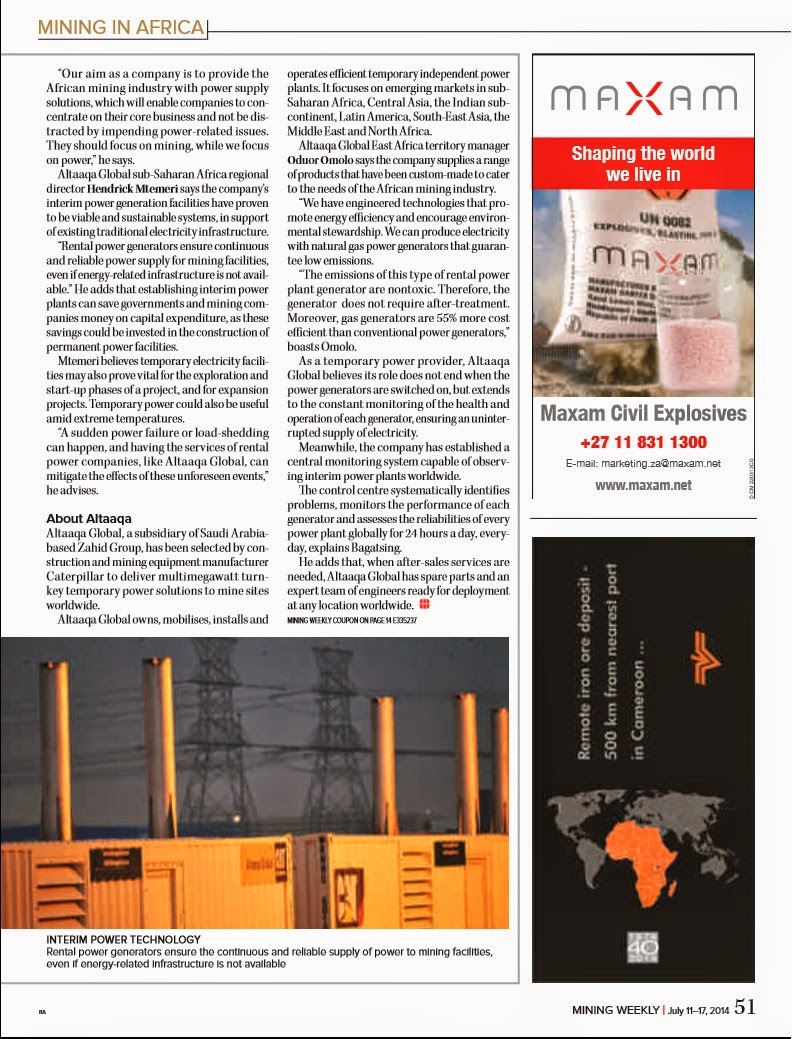
The deficiency in power generation on the African continent is impacting on the mining industry’s ability to reach its full production potential, thereby impacting on the industry’s ability to boost the continent’s economy, says Dubai- based temporary power solutions provider Altaaqa Global CAT Rental Power marketing manager Robert Bagatsing.


He tells Mining Weekly that power is necessary for all mining operations and that its absence could lead to significant financial, operational and social losses.

“It is crucial to maintain a continuous and reliable power supply at mining locations. A few minutes without electricity can halt operations and endanger the lives of mineworkers – for instance, in cases of extreme weather,” says Bagatsing, adding that a brief power outage can also impact significantly on the profits of an operation.

African Expansion

Altaaqa Global CAT Rental Power opened a Southern African branch, in Johannesburg, this year, which caters to several African countries, including South Africa, Angola, Botswana, Mozambique, Madagascar, Malawi, Namibia, Zambia and Zimbabwe.

Altaaqa Global Southern Africa territory manager Paul Heyns says the new office is part of the company’s drive to be closer to its clients and react more swiftly to their requirements. The expansion is part of the company’s over- arching vision of being Africa’s preferred temporary power solutions provider by 2022.

Altaaqa Global believes that upgrading existing power generation facilities and constructing new electricity plants to boost the supply of power to remote mining locations are two probable and lasting solutions to the power problems facing Africa’s mining industry.

However, Bagatsing says this is easier said than done, as it can take up to five or even ten years for a power plant to become operational.

“Industry stakeholders, including governments, banks, regulatory and policymaking bodies, suppliers and contractors, should all agree on the start-up of a new power project and should commit to seeing it through to the final production stage. It takes only one dissenting incident for a particular power project to be shelved.”

Bagatsing warns that mining companies cannot afford to continue facing the economic and operational consequences of unstable or absent power without assistance from other industry stakeholders.

Immediate Solution

With the mining industry’s reliance on energy and the impact of power supply disruptions on production and costs, an urgent solution is necessary to keep the mining industry afloat, says Bagatsing, adding that the industry needs a resolution now, not in five or ten years’ time.

“It may just be a matter of introducing the concept of interim power technology to the region. We believe that Africa will soon have a better understanding of the benefits of rental-energy technology and will, therefore, be able to grasp its potential.

“Our aim as a company is to provide the African mining industry with power supply solutions, which will enable companies to concentrate on their core business and not be distracted by impending power-related issues. They should focus on mining, while we focus on power,” he says.

Altaaqa Global sub-Saharan Africa regional director Hendrick Mtemeri says the company’s interim power generation facilities have proven to be viable and sustainable systems, in support of existing traditional electricity infrastructure.

“Rental power generators ensure continuous and reliable power supply for mining facilities, even if energy-related infrastructure is not available.”

He adds that establishing interim power plants can save governments and mining companies money on capital expenditure, as these savings could be invested in the construction of permanent power facilities.

Mtemeri believes temporary electricity facilities may also prove vital for the exploration and start-up phases of a project, and for expansion projects. Temporary power could also be useful amid extreme temperatures.

“A sudden power failure or load-shedding can happen, and having the services of rental power companies, like Altaaqa Global, can mitigate the effects of these unforeseen events,” he advises.


About Altaaqa

Altaaqa Global, a subsidiary of Saudi Arabia-based Zahid Group, has been selected by construction and mining equipment manufacturer Caterpillar to deliver multimegawatt turnkey temporary power solutions to mine sites worldwide.

Altaaqa Global owns, mobilises, installs and operates efficient temporary independent power plants. It focuses on emerging markets in sub- Saharan Africa, Central Asia, the Indian subcontinent, Latin America, South-East Asia, the Middle East and North Africa.

Altaaqa Global East Africa territory manager Oduor Omolo says the company supplies a range of products that have been custom-made to cater to the needs of the African mining industry.

“We have engineered technologies that promote energy efficiency and encourage environmental stewardship. We can produce electricity with natural gas power generators that guarantee low emissions.

“The emissions of this type of rental power plant generator are nontoxic. Therefore, the generator does not require after-treatment. Moreover, gas generators are 55% more cost efficient than conventional power generators,” boasts Omolo.

As a temporary power provider, Altaaqa Global believes its role does not end when the power generators are switched on, but extends to the constant monitoring of the health and operation of each generator, ensuring an uninter- rupted supply of electricity.

Meanwhile, the company has established a central monitoring system capable of observing interim power plants worldwide. The control centre systematically identifies problems, monitors the performance of each generator and assesses the reliabilities of every power plant globally for 24 hours a day, everyday, explains Bagatsing.

He adds that, when after-sales services are needed, Altaaqa Global has spare parts and an expert team of engineers ready for deployment at any location worldwide.

END

* The above article originally appeared in the July 11-17, 2014 issue of Mining Weekly, published by Creamer Media. Read more: http://bit.ly/1jwDTOB


PRESS INQUIRIES

Robert Bagatsing
Altaaqa Global
Tel: +971 56 1749505
rbagatsing@altaaqaglobal.com